Links marked See on Amazon are affiliate links — buy through one and we earn a commission at no cost to you. How that works, and how the picks are made.
For most tanks: an Eheim Jager sized by the calculator, with a $35 Inkbird controller in front of it — the most reliable heater made, with the one weakness it has (a mechanical thermostat that can fail closed) covered by the controller. Under about 40 gallons, the Aqueon Pro Adjustable: shatterproof, and the only heater here whose maker states it switches itself off on over-temperature — which matters most on a small tank, because that is where a stuck heater cooks fastest. Over about 75 gallons or in a sump, a titanium element with its own controller. And on every tank, two smaller heaters beat one big one, because a stuck heater half the size does half the damage — the numbers are below.
A heater is the one piece of equipment that can kill everything in the tank in an afternoon, and the reviews rank them by how easy the dial is to turn. This page is organized around the thing that matters instead: what each heater does to each size of tank when it works, and when it doesn't. Every range and every temperature below is computed by the same heat-loss engine as the heater wattage calculator, for a standard tank of that size holding 78 °F in a room that drops to 68 °F overnight.
Which heater for your tank
The answer, for the common lidded sizes, sized by the same rule as the calculator (runs no more than 60 % of the time on a 68 °F night; split in two from 200 W) and matched to the heater that is right at that size. Open-top tanks lose about twice as much and need the next size up — the calculator handles that.
| Your tank (lidded) | Buy this | Runs | If it sticks on | Controller |
|---|---|---|---|---|
| 10 gallon | Aqueon Pro Adjustable 50 W | 56 % of the night | 86 °F | built in — it shuts itself off |
| 20 gallon long | Eheim Jager TruTemp 75 W | 56 % of the night | 86 °F | + Inkbird ITC-306T |
| 29 gallon | Aqueon Pro Adjustable 100 W | 55 % of the night | 86 °F | built in — it shuts itself off |
| 40 gallon breeder | Aqueon Pro Adjustable 150 W | 48 % of the night | 89 °F | built in — it shuts itself off |
| 55 gallon | 2 × Eheim Jager TruTemp 100 W | 47 % of the night | 79 °F with one of the pair stuck | + Inkbird ITC-306T |
| 75 gallon | 2 × Eheim Jager TruTemp 100 W | 54 % of the night | 77 °F with one of the pair stuck | + Inkbird ITC-306T |
| 90 gallon | 2 × Eheim Jager TruTemp 100 W | 59 % of the night | 77 °F with one of the pair stuck | + Inkbird ITC-306T |
| 125 gallon | 2 × Eheim Jager TruTemp 150 W | 50 % of the night | 78 °F with one of the pair stuck | + Inkbird ITC-306T |
Standard tank dimensions and typical glass, 78 °F water, room at 68 °F, glass lid. Sizes rounded up to what the line sells; "runs" is the duty cycle on the coldest night. Product links to Amazon are affiliate links. Your own tank — dimensions, lid, coldest room — goes through the calculator.
At a glance
| Heater | Sizes | Thermostat | Over-temp cutoff | Dry-run cutoff | Shatterproof | Warranty | Street price |
|---|---|---|---|---|---|---|---|
| Eheim Jager TruTemp | 25–300 W | Mechanical | No | Yes | No | 3 yr | $25–40 |
| Fluval E Series | 50–300 W | Electronic | — | Yes | No | 5 yr | $45–80 |
| Aqueon Pro Adjustable | 50–300 W | Electronic | Yes | Yes | Yes | — | $25–45 |
| Hygger Titanium with external controller | 50–500 W | External | — | Yes | Yes | — | $45–85 |
| Finnex HMX-S titanium with digital controller | 100–500 W | External | — | — | Yes | — | $60–110 |
From each maker's page or a specialist retailer's listing, checked on the date at the top. A dash means the maker does not state it and we do not credit it; several heaters may well have the protection. Prices are broad bands from specialist retailers, not Amazon.
How we ranked them
Three things, in this order. What it does when it fails — whether the thermostat is mechanical or electronic, whether there is an independent over-temperature cutoff behind it, whether it shuts off when run dry. Whether the sizes on offer are honest — we put the physics beside the maker's gallon rating for every size, and you can see where they agree and where the box is generous. Then the ordinary things: accuracy, range, warranty, whether it survives a cichlid. Price bands are from specialist retailers, checked on the date at the top; the exact price is whatever the shop says today. Commission is not a factor, and one of the six picks earns us nothing at all.
The picks
Eheim Jager TruTemp
Any tank where you will pair it with a controller — which, on anything you would grieve for, you should.
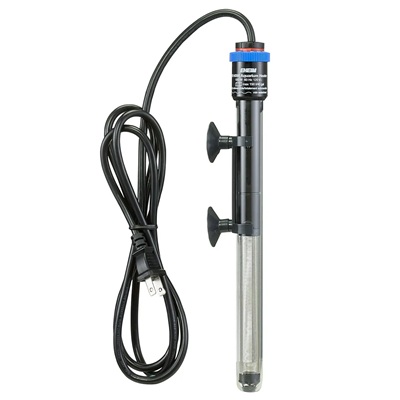
- Thermostat
- Mechanical (bimetal)
- Body
- Glass
- Range
- 65–93 °F
- Accuracy
- ±1 °F
- Over-temp cutoff
- No
- Warranty
- 3 years
- Sizes
- 25–300 W
- Street price
- $25–40 (2026-08)
| Size | Box says | Physics, lidded | Physics, open top | If it sticks on |
|---|---|---|---|---|
| 25 W · 9 in → | 5–7 gal | keeps up on a 5.5 gal, no headroom | nothing standard at a 10 °F gap | 82 °F on a lidded 5.5 gallon |
| 50 W · 9 in → | 7–16 gal | a 10 gal | keeps up on a 5.5 gal, no headroom | 95 °F on a lidded 5.5 gallon · cooks ≤ 5.5 gal |
| 75 W · 10.2 in → | 16–26 gal | 15–20 gal | a 5.5 gal | 89 °F on a lidded 15 gallon · cooks ≤ 10 gal |
| 100 W · 12.2 in → | 26–40 gal | 20–29 gal (a 20 long cooks) | a 10 gal | 86 °F on a lidded 29 gallon · cooks ≤ 15 gal |
| 125 W · 12.2 in → | 40–53 gal | 29–40 gal | 10–15 gal | 85 °F on a lidded 40 gallon breeder · cooks ≤ 20 gal |
| 150 W · 13.4 in → | 53–79 gal | a 40 gal | 15–20 gal | 84 °F on a lidded 55 gallon · cooks ≤ 37 gal |
| 200 W · 15.7 in → | 79–106 gal | 55–90 gal | 20–37 gal (a 20 high cooks) | 87 °F on a lidded 75 gallon · cooks ≤ 40 gal |
| 250 W · 17.8 in → | 106–159 gal | 75–120 gal | a 37 gal | 86 °F on a lidded 120 gallon · cooks ≤ 65 gal |
| 300 W · 19.6 in → | 159–264 gal | 120–125 gal | 40–55 gal | 85 °F on a lidded 150 gallon · cooks ≤ 90 gal |
"Box says" is Eheim's own rating where we could read it (source: Bulk Reef Supply listing, re-checked 31 Aug 2026); the size links go where the button below does. Physics columns: the standard tanks this size runs at or under 60 % duty for, 78 °F water in a 68 °F room. Stuck-on temperature is on the smallest tank a buyer would put it on, lidded — red is above 91 °F, where tropical fish die within hours.
- Nine sizes, and the only line here with a 125 W and a 250 W — the gaps other makers skip.
- A recalibration ring: if the dial reads 2 °F off your thermometer, you correct it once instead of living with the offset.
- Dry-run protection cuts the element if the water drops below it during a water change.
- Three-year warranty on a heater that costs about thirty dollars, which tells you what the failure rate is.
- A mechanical bimetal thermostat: reliable for years, and when it finally fails it can fail with the contacts closed — on. There is no over-temperature cutoff behind it.
- Long. The 300 W is nearly 20 inches and needs a tall tank or a sump.
- Glass, and toughened rather than shatterproof: a large cichlid or a dropped rock can break it.
Fluval E Series
The tank you look at every day: the display tells you the water temperature at a glance and changes color when it drifts.
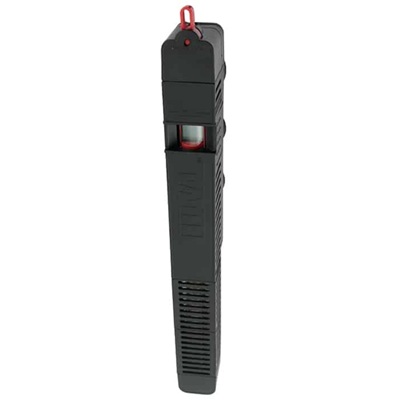
- Thermostat
- Electronic
- Body
- Glass
- Range
- 68–93 °F
- Accuracy
- ±1 °F
- Over-temp cutoff
- —
- Warranty
- 5 years
- Sizes
- 50–300 W
- Street price
- $45–80 (2026-08)
| Size | Box says | Physics, lidded | Physics, open top | If it sticks on |
|---|---|---|---|---|
| 50 W → | up to 15 gal | a 10 gal | keeps up on a 5.5 gal, no headroom | 86 °F on a lidded 10 gallon · cooks ≤ 5.5 gal |
| 100 W · 11.8 in → | up to 30 gal | 20–29 gal (a 20 long cooks) | a 10 gal | 92 °F on a lidded 20 gallon long · cooks ≤ 15 gal |
| 200 W · 14 in → | up to 65 gal | 55–90 gal | 20–37 gal (a 20 high cooks) | 90 °F on a lidded 55 gallon · cooks ≤ 40 gal |
| 300 W · 14 in → | up to 100 gal | 120–125 gal | 40–55 gal | 90 °F on a lidded 120 gallon · cooks ≤ 90 gal |
"Box says" is Fluval's own rating where we could read it (source: Fluval USA product pages); the size links go where the button below does. Physics columns: the standard tanks this size runs at or under 60 % duty for, 78 °F water in a 68 °F room. Stuck-on temperature is on the smallest tank a buyer would put it on, lidded — red is above 91 °F, where tropical fish die within hours.
- Two temperature sensors and a display that turns from green to amber or red when the water is ±2 °F from the set point — a thermometer and an alarm you did not have to buy.
- Sets in 0.5° steps; the longest warranty in this list at five years.
- A plastic fish guard around the glass, and a low-water shut-off (the "LF" code).
- That LF shut-off also trips on low flow: it wants water moving past it, and in a still corner it will sulk and stop heating. Put it near the filter outlet.
- Bulkier than the wattage suggests because of the guard; the 300 W is the same length as the 200 W.
- Fluval's page describes the over-temperature response as an alert, so we count it as a warning rather than a cutoff.
Aqueon Pro Adjustable
Small tanks and ordinary tropical community tanks: shatterproof, self-limiting, and the cheapest heater here that states an over-temperature cutoff — which matters most on the small tanks a stuck heater cooks fastest.
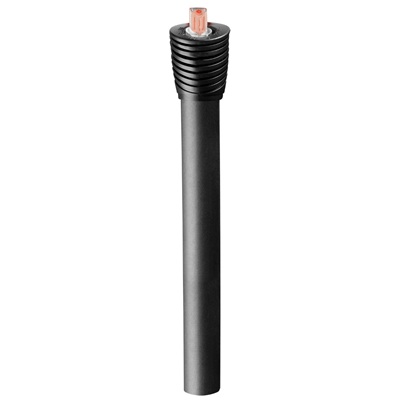
- Thermostat
- Electronic
- Body
- Shatterproof plastic
- Range
- 68–88 °F
- Accuracy
- ±1 °F
- Over-temp cutoff
- Yes
- Warranty
- —
- Sizes
- 50–300 W
- Street price
- $25–45 (2026-08)
| Size | Box says | Physics, lidded | Physics, open top | If it sticks on |
|---|---|---|---|---|
| 50 W → | up to 20 gal | a 10 gal | keeps up on a 5.5 gal, no headroom | 86 °F on a lidded 10 gallon · cooks ≤ 5.5 gal |
| 100 W → | up to 40 gal | 20–29 gal (a 20 long cooks) | a 10 gal | 92 °F on a lidded 20 gallon long · cooks ≤ 15 gal |
| 150 W → | — | a 40 gal | 15–20 gal | 89 °F on a lidded 40 gallon breeder · cooks ≤ 37 gal |
| 200 W → | — | 55–90 gal | 20–37 gal (a 20 high cooks) | 90 °F on a lidded 55 gallon · cooks ≤ 40 gal |
| 300 W → | — | 120–125 gal | 40–55 gal | 90 °F on a lidded 120 gallon · cooks ≤ 90 gal |
"Box says" is Aqueon's own rating where we could read it (source: Aqueon product page and retailer listings); the size links go where the button below does. Physics columns: the standard tanks this size runs at or under 60 % duty for, 78 °F water in a 68 °F room. Stuck-on temperature is on the smallest tank a buyer would put it on, lidded — red is above 91 °F, where tropical fish die within hours.
- Shatterproof thermoplastic and a stated auto shut-off — "Auto Shut-Off when over-heats, resets when it cools down" — at the price of a basic glass heater.
- A dial, so the setting survives a power cut, and an LED that shows when it is heating.
- Five sizes up to 300 W.
- The narrowest range here, 68–88 °F: fine for tropicals, no use for a cool-water tank held at 65 or a fever tank at 90.
- ±1 °F and no display — pair it with a thermometer.
- Aqueon's page states ratings we could verify only for the 50 W and 100 W; the others are physics only below.
Hygger Titanium with external controller
A 75 to 120 gallon tank or a sump, where a single glass heater is either too long or too much of a gamble.
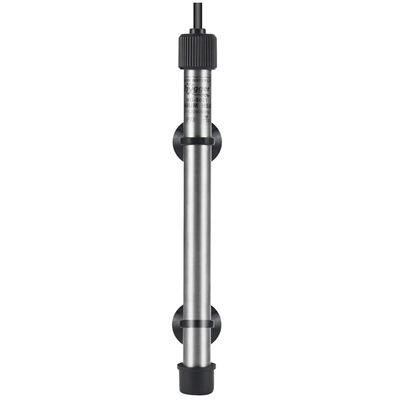
- Thermostat
- External controller
- Body
- Titanium
- Range
- 32–104 °F
- Accuracy
- ±1 °F
- Over-temp cutoff
- —
- Warranty
- —
- Sizes
- 50–500 W
- Street price
- $45–85 (2026-08)
| Size | Box says | Physics, lidded | Physics, open top | If it sticks on |
|---|---|---|---|---|
| 50 W → | 5–10 gal | a 10 gal | keeps up on a 5.5 gal, no headroom | 95 °F on a lidded 5.5 gallon · cooks ≤ 5.5 gal |
| 100 W → | 10–25 gal | 20–29 gal (a 20 long cooks) | a 10 gal | 104 °F on a lidded 10 gallon · cooks ≤ 15 gal |
| 200 W → | 20–45 gal | 55–90 gal | 20–37 gal (a 20 high cooks) | 116 °F on a lidded 20 gallon long · cooks ≤ 40 gal |
| 500 W → | 60–120 gal | cooks every standard tank to 210 gal | 75–120 gal | 122 °F on a lidded 55 gallon · cooks ≤ 210 gal |
"Box says" is Hygger's own rating where we could read it (source: Hygger HG802 product page and specialist-retailer listings, corrected 27 Aug 2026); the size links go where the button below does. Physics columns: the standard tanks this size runs at or under 60 % duty for, 78 °F water in a 68 °F room. Stuck-on temperature is on the smallest tank a buyer would put it on, lidded — red is above 91 °F, where tropical fish die within hours.
- A titanium element with the thermostat outside the water in a controller box with a probe — the controller-plus-element layout, in one purchase.
- Unbreakable, corrosion-proof, and happy in salt water.
- A 32–104 °F range, which is the widest here and covers coldwater and fever tanks alike.
- Hygger's page says the element stops at the set point and restarts a degree below it; it does not clearly describe an independent over-temperature cutoff, so we do not credit one.
- Two things to mount and a probe to route; the probe placement decides the accuracy.
- Hygger claims ±0.2 °F. That is the display resolution of the controller, not a thermostat that holds a fifth of a degree, so the accuracy above is the ±1 °F we would expect in a tank — treat the claim on the box as marketing.
- A jump from the 200 W (rated to 45 gal) straight to the 500 W (from 60 gal) with nothing in between, and the 500 W is a different part number (HG902) with a different element.
- A brand that changes models often, and several similar-looking hygger heaters are not titanium — check the listing shows the titanium tube and the HG802 controller.
Finnex HMX-S titanium with digital controller
A reef sump, where the element lives out of sight in salt water and the controller lives on the cabinet door.
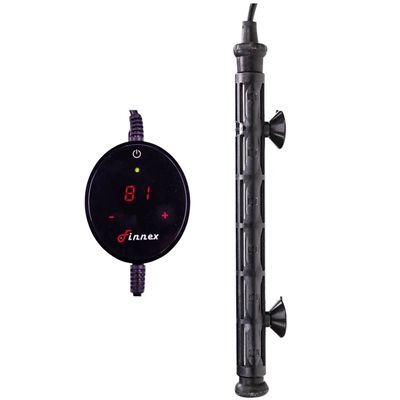
- Thermostat
- External controller
- Body
- Titanium
- Range
- 59–95 °F
- Accuracy
- ±2 °F
- Over-temp cutoff
- —
- Warranty
- —
- Sizes
- 100–500 W
- Street price
- $60–110 (2026-08)
| Size | Box says | Physics, lidded | Physics, open top | If it sticks on |
|---|---|---|---|---|
| 100 W → | — | 20–29 gal (a 20 long cooks) | a 10 gal | 92 °F on a lidded 20 gallon long · cooks ≤ 15 gal |
| 200 W → | — | 55–90 gal | 20–37 gal (a 20 high cooks) | 90 °F on a lidded 55 gallon · cooks ≤ 40 gal |
| 300 W → | — | 120–125 gal | 40–55 gal | 90 °F on a lidded 120 gallon · cooks ≤ 90 gal |
| 500 W → | — | cooks every standard tank to 210 gal | 75–120 gal | 111 °F on a lidded 90 gallon · cooks ≤ 210 gal |
"Box says" is Finnex's own rating where we could read it (source: Bulk Reef Supply and specialist retailer listings); the size links go where the button below does. Physics columns: the standard tanks this size runs at or under 60 % duty for, 78 °F water in a 68 °F room. Stuck-on temperature is on the smallest tank a buyer would put it on, lidded — red is above 91 °F, where tropical fish die within hours.
- Titanium element and a touch-pad controller with a clear display that remembers the set point through a power cut.
- Includes a plastic guard over the element, and the reef retailers stock it, which is where you want to buy a reef heater.
- We earn nothing on this one — linked because it is the right product, from the right shop.
- Rated ±2 °F, the loosest here; on a reef that is the whole width of the temperature band, so put a controller in front of it anyway.
- No stated dry-run protection — an element out of water is a fast way to ruin it.
- Finnex does not publish gallon ratings we could verify; physics only below.
What size aquarium heater do I need?
Not watts per gallon. Heat leaves a tank through its surfaces, and the surfaces scale with area while gallons scale with volume — so the rule over-sizes small tanks and under-sizes big ones, and it says nothing about the two things that actually set the number: the gap to the coldest the room gets, and whether the top is open. An open-top tank loses about half its heat as evaporation, which a lid nearly eliminates. Here is what each common wattage is actually for, against the rule everyone quotes:
| Heater | 3 W/gal says | Physics, lidded | Physics, open top | Cooks if stuck (lidded) |
|---|---|---|---|---|
| 50 W | 17 gal | a 10 gal; keeps up to a 20 with no headroom | keeps up on a 5.5 gal, no headroom | anything ≤ 5.5 gal |
| 75 W | 25 gal | 15–20 gal; keeps up to a 40 with no headroom | a 5.5 gal; keeps up to a 15 with no headroom | anything ≤ 10 gal |
| 100 W | 33 gal | 20–29 gal; keeps up to a 65 with no headroom — a 20 long cooks | a 10 gal; keeps up to a 20 with no headroom | anything ≤ 15 gal |
| 150 W | 50 gal | a 40 gal; keeps up to a 120 with no headroom | 15–20 gal; keeps up to a 37 with no headroom | anything ≤ 37 gal |
| 200 W | 67 gal | 55–90 gal; keeps up to a 180 with no headroom | 20–37 gal; keeps up to a 65 with no headroom — a 20 high cooks | anything ≤ 40 gal |
| 300 W | 100 gal | 120–125 gal; keeps up to a 210 with no headroom | 40–55 gal; keeps up to a 120 with no headroom | anything ≤ 90 gal |
| 500 W | 167 gal | cooks every standard tank to 210 gal | 75–120 gal; keeps up to a 210 with no headroom | anything ≤ 210 gal |
Computed by this site's heat-loss engine over the standard tank sizes (5.5 to 210 gallons, typical glass for the height), 78 °F water, a room at 68 °F, 50 % humidity. "Cooks" is a stuck-on equilibrium above 91 °F. Evaporation grows faster than linearly with temperature, so real runaway is slightly lower than printed — the conservative direction.
Read the 100 W row. The rule says a 100 W heater is a 33 gallon heater; the box on the Jager says 26–40; the physics says 20–29 gal; keeps up to a 65 with no headroom — a 20 long cooks with a lid, which is the box being roughly right — and then says the same heater takes a lidded 10 gallon to 104 °F if it sticks, while on a lidded 29 it stops at 86 °F. That is why the small end of each range on this page matters as much as the large end, and why the calculator rounds your tank to a size you can buy and then prints the stuck-on temperature for it.
Follow the 500 W row across: at a 10 °F gap there is no standard tank, up to the 210 gallon, that a single 500 W heater is the right size for with a lid on — every one of them goes past 91 °F if it sticks. A 500 W is an open-top or sump heater, or the element behind a controller, and the Hygger 500 W's box rating of 60–120 gallons is a rating for a tank with no lid. That is not a criticism of the heater; it is the reason the controller section below exists.
The Jager box rates its 75 W for 16–26 gallons and its 100 W for 26–40, so a 29 wants the 100. The physics agrees, and says why: the 75 W runs 74 % of the time on the coldest night — keeps up with no headroom, over the 60 % target — and would stop at 82 °F stuck on; the 100 W runs 55 % (comfortable) and stops at 86 °F. The 75 is 5 °F safer if it sticks and a size too small for a cold snap; the 100 is right, and its stuck-on 86 °F is survivable for a day. The controller below turns the question academic either way.
How aquarium heaters fail, and which ones protect you
Four ways, in order of how much damage they do:
- Stuck on. A bimetal thermostat's contacts weld, or an electronic heater's relay does, and the element runs until the water hits whatever the heater's wattage and the tank's heat loss settle at — the temperature in the tables above. This is the one that kills tanks, and the only protections against it are an independent over-temperature cutoff inside the heater, a controller outside it, or a heater small enough that the equilibrium is survivable.
- Stuck off. The same failure the other way. Slow, and a thermometer catches it days before it matters; the danger is a winter weekend away.
- Cracked glass. A cold water change onto a hot heater, a rock, a large fish. Water reaches the element, the breaker or GFCI trips, and the tank cools — bad, but usually not lethal. Shatterproof bodies remove it.
- Forgotten settings. A power cut resets some digital heaters to a default. A dial cannot forget; the digital heaters here all state that they remember.
Which heater protects against which is the at-a-glance table above, and the pattern in it is the argument for a controller. Of the 5 heaters here, exactly one states an over-temperature cutoff — Aqueon Pro Adjustable — and the rest either say plainly that they have none (Eheim Jager TruTemp) or describe an alert without committing to switching the element off, which we count as a warning rather than a cutoff. The Jager is the case worth sitting with: the best reliability record in the hobby and no cutoff, so when it finally fails, the failure is the dangerous one. That is the whole reason the Jager pick above comes with a controller attached, and why a heater that shuts itself off is worth more on a small tank than a tenth of a degree of accuracy.
A stated cutoff is a claim by the maker about a thermal fuse or a software limit inside the same device whose thermostat has just failed. It is worth having, and it is not independent: one board, one sensor, one failure. A separate controller is a second device with its own probe that cuts mains power to the heater, and that independence is the whole point. On a small tank a self-limiting heater is a sensible economy; on anything you would grieve for, the controller is the answer whatever the box says.
Do I need a temperature controller?
On any tank you would grieve for, yes, and it is the best-value purchase on this page. A controller is a plug-in thermostat with its own probe: the heater plugs into it, the probe goes in the tank, and the controller switches the heater's power. The heater's own thermostat then becomes a backstop rather than the only line of defense. Set the heater's dial 2 °F above the controller's set point: in normal running the controller does all the switching and the heater is always "on" when powered; if the controller's relay ever welds, the heater's own thermostat still stops it 2 °F later; if the heater's thermostat welds, the controller cuts its power at the set point. Two independent failures are needed to cook the tank instead of one.
Inkbird ITC-306T (aquarium probe)
Two heater outlets on one probe, so a pair of heaters shares one brain. Heating only — the right one for almost every freshwater tank.
- Stages
- Heating only
- Outlets
- 2, 1200 W total
- Alarms
- Over-temperature and probe-fault alarms
- Street price
- $30–40
Inkbird ITC-308 / 308S
One heating outlet and one cooling outlet — a heater and a fan or chiller from the same probe, which is what a reef in a warm room wants. The 308S has a replaceable probe; the WiFi version texts you when the tank drifts.
- Stages
- Heating + cooling
- Outlets
- 2, 1200 W total
- Alarms
- High and low temperature alarms, probe-fault alarm
- Street price
- $30–40 ($50–60 WiFi)
Freshwater: the ITC-306T, because its two outlets run a pair of heaters from one probe, which is the layout the next section argues for. Reef, or any tank that also runs a fan or chiller in summer: the 308, whose second outlet is a cooling stage. Put the probe where the heater is not — the far end of the tank — so it reads the water rather than the heater's plume, and check it against a separate thermometer once a month. A controller is a second thermostat, and a second thermostat can also be wrong; what it cannot be is wrong at the same time, in the same direction as the first.
One heater or two?
Two, above about 200 W, and the arithmetic is the argument. On a lidded 75 gallon at the design conditions, one 200 W heater stuck on settles the water at 87 °F. Replace it with two 100 W heaters and either one stuck on settles at 77 °F — below the set point, because one heater of the pair cannot hold this tank alone in a 68 °F room: the failure is literally harmless. Two heaters also mean a stuck-off failure leaves the tank at half heat instead of none, and that a heater replaced on schedule leaves a working one in the water while you wait for the delivery. The calculator splits the size for you and prints both numbers; the same 75 with an open top and one 300 W stuck on goes to 81 °F, which is the number to remember if you keep a big open-topped tank on a single heater.
Glass, plastic or titanium?
Glass is cheap, accurate and the default; toughened glass (the Jager) survives most knocks, ordinary glass does not survive a cold water change poured onto a hot element. Shatterproof thermoplastic (Aqueon Pro Adjustable) removes breakage as a failure mode entirely and is what to use with large or boisterous fish; the plastic conducts heat less well, which the makers compensate for with flat, wide bodies. Titanium is unbreakable and immune to salt, and it always comes as a bare element plus a controller, because titanium elements have no thermostat of their own — which makes the titanium options here the controller-plus-element layout by construction, and the right choice for a sump, where nobody will see it and nothing will hit it.
What we'd skip
- Preset, non-adjustable heaters. Sold for bettas and nanos at a fixed 78 °F with no thermostat you can check or trim. When they fail on, they fail on in the smallest tanks, which are the ones the tables above show cook fastest.
- One big heater on a tank it is generous for. A 300 W on a 40 gallon "so it has plenty of power" is the single most common way this equipment kills fish. Read its stuck-on column first.
- Unbranded heaters with no stated protections. The marketplace is full of heaters at half the Jager's price that state a wattage and nothing else. The thing you are paying for in a heater is what it does when it breaks, and "nothing stated" is the honest reading of "nothing".
- A titanium element without its controller. Some are sold separately. An element alone is a kettle.
- Sizing by 5 watts per gallon. The upper end of the old rule; on a lidded tank in a heated home it buys a heater two sizes too big, and all of that surplus turns into runaway.
Common questions
Where should the heater go in the tank?
Where water moves past it — near the filter outlet or a powerhead — so the thermostat reads the tank rather than its own warm bubble. Horizontal near the bottom keeps the element under water through a water change and heats more evenly than vertical in a corner. Digital heaters with a low-flow shut-off (the Fluval E in particular) genuinely need flow across them or they stop.
Do I need a heater at all?
If the room never drops more than a couple of degrees below the temperature you keep the tank at, no — and a great many living-room tanks in centrally heated homes are in that position. The test is the coldest night of the year, not the average day: a tank that is fine in October and 68 °F in January needs the heater in January. The sizing calculator takes the coldest room temperature as an input for exactly that reason.
How long does an aquarium heater last?
Three to five years is typical, and the failure is rarely graceful. A mechanical thermostat that has been clicking on and off twenty times a day for four years is on borrowed time, and it can fail in either position. The cheapest insurance in fishkeeping is replacing a heater on a schedule rather than on failure, and keeping the old one as a spare for the quarantine tank.