Links marked See on Amazon are affiliate links — buy through one and we earn a commission at no cost to you. How that works, and how the picks are made.
For a 20 to 75 gallon freshwater tank, a Fluval 07 at the size the table below gives — quiet enough, self-priming, and the one maker that prints what its pump really moves. For the most media per dollar and per watt, an Eheim Classic, if you can live without a priming button. For the tank you sit next to, the Oase BioMaster 2 Thermo: quietest measured, and a pre-filter you rinse without opening it. Over about 90 gallons, an FX4 or FX6, or the Aquael Ultramax if the cabinet is short or the power bill matters. And whatever you buy, read its gallon rating as the table reads it — the "up to 200 gallons" on a 350 GPH box is a 40–90 gallon filter.
A canister filter's box carries two numbers, and both are marketing. The gallon rating is scaled to nothing you can check, and the flow rating is measured at the pump with empty baskets and no hose — with media in, a canister moves about half to two thirds of it. The reviews rank filters by those numbers anyway. This page ranks them by what the numbers mean: every range below is the hobby's own turnover rule (4–6× an hour for freshwater, 8–10× for planted) run by the filter size calculator's engine over the standard tank sizes, and every "really moves" figure is the maker's own where they publish one.
Which canister filter for your tank
The smallest filter in this comparison that the turnover rule calls right for each standard tank, moderately stocked, freshwater and planted. Where two lines tie on the rule, the cheaper one is listed; the cards below say when the dearer one is worth it.
| Your tank | Freshwater (4–6×) | Really moves | Planted (8–10×) | Runs on |
|---|---|---|---|---|
| 20 gallon long | Fluval 107 | 5.5× an hour | Fluval 107 | 10 W · $16/yr |
| 29 gallon | Fluval 107 | 3.6× an hour | Fluval 307 | 10 W · $16/yr |
| 40 gallon breeder | Fluval 207 | 2.9× an hour | Fluval 407 | 10 W · $16/yr |
| 55 gallon | Fluval 307 | 3.8× an hour | Aquael Ultramax 2000 | 16 W · $25/yr |
| 75 gallon or two smaller — see below | Fluval 307 | 2.8× an hour | Fluval FX4 | 16 W · $25/yr |
| 90 gallon or two smaller — see below | Fluval 407 | 2.9× an hour | Fluval FX4 | 23 W · $36/yr |
| 125 gallon or two smaller — see below | Aquael Ultramax 2000 | 2.6× an hour | Fluval FX6 | 24 W · $38/yr |
| 180 gallon or two smaller — see below | Fluval FX6 | 3.1× an hour | nothing here fits — two filters, or a sump | 41 W · $65/yr |
Standard tank dimensions filled to an inch under the rim over two inches of gravel; the rule applied to the box rating, as it was written; "really moves" is the maker's circulation figure where published, otherwise 55 % of the rating. Running cost at $0.18/kWh, 24 hours a day. Amazon links are affiliate links. Your own volume and stocking go through the calculator.
At a glance
| Filter | Sizes | Priming | Pre-filter | Noise | Media | Runs on | Street price |
|---|---|---|---|---|---|---|---|
| Fluval 07 series (107 / 207 / 307 / 407) | 145 GPH–383 GPH | Button | No | 49 dB | 1.6–4.2 L* | 10–23 W | $110–260 |
| Eheim Classic (2211 / 2213 / 2215 / 2217) | 79 GPH–264 GPH | Manual | No | — | 1–6 L | 5–20 W | $115–255 |
| Oase BioMaster 2 Thermo (250 / 350 / 600 / 850) | 238 GPH–396 GPH | Button | Yes | 43 dB | 4.4–8 L | 15–25 W | $280–470 |
| Fluval FX2 / FX4 / FX6 | 476 GPH–925 GPH | Button | No | — | 3.9–5.9 L | 27–41 W | $250–410 |
| Aquael Ultramax (1000 / 1500 / 2000) | 264 GPH–528 GPH | Button | Yes | — | 5.7–9.5 L | 15–24 W | $195–300 |
| Penn-Plax Cascade (500 / 700 / 1000 / 1200 / 1500) | 115 GPH–350 GPH | Button | No | — | 2.2–6.6 L* | 10.5–45.5 W | $105–170 |
| SunSun HW-704B | 525 GPH | Button | No | — | 9 L | 45 W | $100–140 |
From each maker's spec sheet or a specialist retailer's listing, checked on the date at the top. Noise is AquariumStoreDepot's measured figure where they tested the model; a dash means nobody has published one. * media estimated from the rating at 5 mL per L/h where the maker does not state it. Prices are broad bands from specialist retailers, not Amazon.
How we ranked them
Three things, in this order. What the numbers really are — the flow with media in, from the maker's own figure where they publish one, and the media volume, stated or estimated; a filter's capacity is media surface, and doubling the flow through a canister adds only about 9 % to it. What it is like to own — priming, a pre-filter you can rinse without opening the canister, noise, and whether the seals and impellers will still be sold in ten years. Then the ordinary things: hose size, a heater in the canister, price. Price bands are from specialist retailers on the date at the top; commission is not a factor, and one pick earns us nothing.
The picks
Fluval 07 series (107 / 207 / 307 / 407)
The ordinary lidded community or planted tank from a 20 to a 75, where quiet, easy priming and a spares supply matter more than raw media.
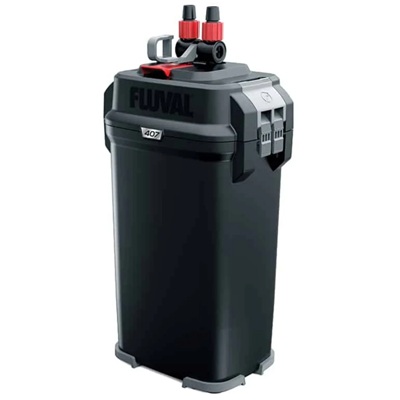
- Priming
- Push-button
- Pre-filter
- No
- Heater
- No
- Noise
- 49 dB measured
- Hoses
- 407: 17 mm; smaller sizes 12–15 mm
- Sizes
- 145 GPH–383 GPH
- Runs on
- 10–23 W · $16–$36 a year
- Street price
- $110–260 (2026-08)
| Size | Box says | Really moves | Media | Physics · a year |
|---|---|---|---|---|
| 107 · 145 GPH · 10 W → | 10–30 gal | 95 GPH (maker's figure) | 1.6 L est. from the line | 20–37 gal freshwater · 15–20 gal planted · $16/yr |
| 207 · 206 GPH · 10 W → | 20–45 gal | 122 GPH (maker's figure) | 2.3 L est. from the line | 29–40 gal freshwater · a 20 gal planted · $16/yr |
| 307 · 304 GPH · 16 W → | 40–70 gal | 206 GPH (maker's figure) | 3.3 L est. from the line | 40–75 gal freshwater · 29–37 gal planted · $25/yr |
| 407 · 383 GPH · 23 W → | 50–100 gal | 246 GPH (maker's figure) | 4.2 L | 55–90 gal freshwater · 29–40 gal planted · $36/yr |
"Box says" is Fluval's own tank rating where we could read it (source: Fluval 07-series spec sheet as reproduced by Bulk Reef Supply and Fluval USA); the size links go where the button below does. "Really moves" is the maker's published circulation figure or, marked est., 55 % of the rating. The last column is the standard tanks the rating is right for at 4–6× (freshwater) and 8–10× (planted), moderately stocked, and what a year costs at $0.18/kWh.
- Fluval publishes the honest number: "filter circulation" beside "pump output" — 930 L/h against 1,450 for the 407 — which almost no other maker does.
- Push-button priming, an AquaStop valve that lets you lift the head off without draining hoses, and parts in every fish shop.
- Low draw for the flow: the 107 and 207 run on 10 W.
- Media baskets are on the small side for the rating — the 407 holds 4.2 L against about 6 L for an Eheim 2217 with a lower pump rating.
- The ribbed hose is stiff and the clamp fittings are the usual leak point when a hose is trimmed short.
- Not the quietest here — 49 dB measured, against 43 for the Oase.
Eheim Classic (2211 / 2213 / 2215 / 2217)
Anyone who values a filter that will still be running in fifteen years over one that primes itself — and every tank where media volume is the point.
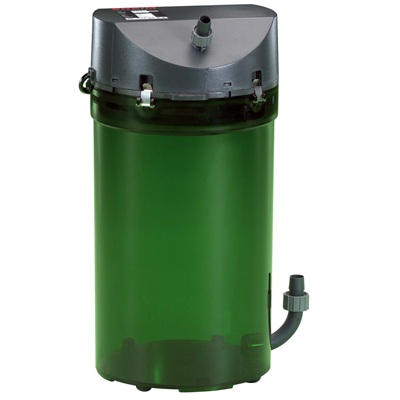
- Priming
- Manual siphon
- Pre-filter
- No
- Heater
- No
- Noise
- —
- Hoses
- 2211: 12/16 mm in, 9/12 mm out; 2213 and 2215: 12/16 mm; 2217: 16/22 mm
- Sizes
- 79 GPH–264 GPH
- Runs on
- 5–20 W · $7.89–$32 a year
- Street price
- $115–255 (2026-08)
| Size | Box says | Really moves | Media | Physics · a year |
|---|---|---|---|---|
| 2211 (Classic 150) · 79 GPH · 5 W → | up to 40 gal | 44 GPH (est.) | 1 L | 10–20 gal freshwater · a 10 gal planted · $7.89/yr |
| 2213 (Classic 250) · 116 GPH · 8 W → | up to 66 gal | 64 GPH (est.) | 3 L | 15–29 gal freshwater · 10–15 gal planted · $13/yr |
| 2215 (Classic 350) · 164 GPH · 15 W → | up to 92 gal | 90 GPH (est.) | 4 L | 20–37 gal freshwater · 15–20 gal planted · $24/yr |
| 2217 (Classic 600) · 264 GPH · 20 W → | 48–158 gal | 145 GPH (est.) | 6 L | 37–65 gal freshwater · 20–37 gal planted · $32/yr |
"Box says" is Eheim's own tank rating where we could read it (source: Eheim spec sheets via aquaristikshop, canister volumes re-checked 30 Aug 2026); the size links go where the button below does. "Really moves" is the maker's published circulation figure or, marked est., 55 % of the rating. The last column is the standard tanks the rating is right for at 4–6× (freshwater) and 8–10× (planted), moderately stocked, and what a year costs at $0.18/kWh.
- A single-chamber canister with no baskets, so nearly the whole volume is media: the 2217 puts 6.0 L of media in a 6.6 L canister — 91 % — where a Fluval FX4 puts 3.9 L in 14 L, or 28 %. Nothing else here is close.
- The lowest draw here for the flow: the 2211 runs on 5 W, the 2213 on 8, the 2217 on 20.
- A design unchanged for decades, which means every seal, impeller and clip is still made and cheap.
- No priming button: you start it by sucking on the outlet hose or with the (sold separately) double-tap valves and a jug of water.
- No pre-filter chamber — a rinse means opening the whole canister.
- Eheim rates the 2213 "up to 66 gallons" on a 440 L/h pump; the physics below says about a third of that at a 4–6× turnover.
Oase BioMaster 2 Thermo (250 / 350 / 600 / 850)
The tank in the living room: the quietest canister measured, a pre-filter you rinse in two minutes without opening it, and the heater out of sight inside the canister.
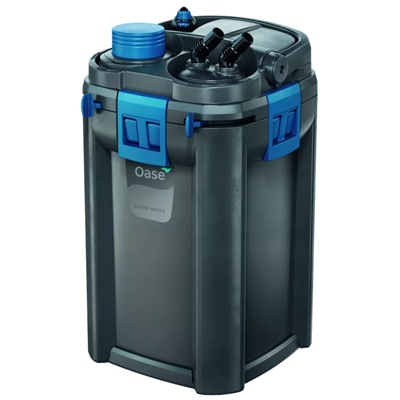
- Priming
- Push-button
- Pre-filter
- Separate, rinse without opening
- Heater
- Built in
- Noise
- 43 dB measured
- Hoses
- 16/22 mm
- Sizes
- 238 GPH–396 GPH
- Runs on
- 15–25 W · $24–$39 a year
- Street price
- $280–470 (2026-08)
| Size | Box says | Really moves | Media | Physics · a year |
|---|---|---|---|---|
| Thermo 250 · 238 GPH · 15 W → | up to 70 gal | 131 GPH (est.) | 4.4 L | 29–55 gal freshwater · 20–29 gal planted · $24/yr |
| Thermo 350 · 291 GPH · 16 W → | up to 90 gal | 160 GPH (est.) | 5.6 L | 37–65 gal freshwater · 29–37 gal planted · $25/yr |
| Thermo 600 · 330 GPH · 23 W → | up to 160 gal | 182 GPH (est.) | 6.8 L | 40–75 gal freshwater · 29–37 gal planted · $36/yr |
| Thermo 850 · 396 GPH · 25 W → | up to 225 gal | 218 GPH (est.) | 8 L | 55–90 gal freshwater · 29–40 gal planted · $39/yr |
"Box says" is Oase's own tank rating where we could read it (source: Oase spec tables via Aquarium Connection, re-checked 30 Aug 2026 for the current BioMaster 2 generation — the only one Oase now lists); the size links go where the button below does. "Really moves" is the maker's published circulation figure or, marked est., 55 % of the rating. The last column is the standard tanks the rating is right for at 4–6× (freshwater) and 8–10× (planted), moderately stocked, and what a year costs at $0.18/kWh.
- The pre-filter basket pulls out of the top with the filter still sealed — a weekly rinse without disturbing the biological media.
- The heater lives in the canister — 150 W in the 250 up to 400 W in the 850 — so nothing is in the tank but the intake and outlet.
- 43 dB measured on the previous-generation BioMaster Thermo, the quietest in the group, and the pump is unchanged: 23 W for 1,250 L/h on the 600.
- Dear for the media you get: the 600 holds 6.8 L for about $370, where an Eheim classic 600 holds 6.0 L for about $255.
- The heater is a glass heater inside a plastic canister: one reviewer notes cracking as a risk when the filter is opened warm. Let it cool first.
- Oase's "up to 160 gallons" for the 600 is a rating for a lightly stocked tank; the physics below puts a moderately stocked freshwater tank at about half that.
Fluval FX2 / FX4 / FX6
A 90 to 210 gallon tank, or a smaller tank of large, messy fish, where a huge mechanical area and a big turnover matter more than biological media volume.
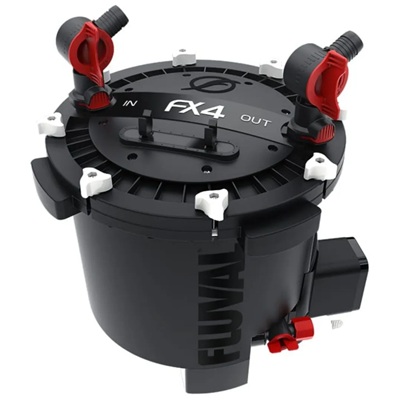
- Priming
- Push-button
- Pre-filter
- No
- Heater
- No
- Noise
- —
- Hoses
- 25 mm (1 in)
- Sizes
- 476 GPH–925 GPH
- Runs on
- 27–41 W · $43–$65 a year
- Street price
- $250–410 (2026-08)
| Size | Box says | Really moves | Media | Physics · a year |
|---|---|---|---|---|
| FX2 · 476 GPH · 27 W → | up to 175 gal | 343 GPH (maker's figure) | 3.9 L | 55–125 gal freshwater · 37–55 gal planted · $43/yr |
| FX4 · 700 GPH · 30 W → | up to 250 gal | 449 GPH (maker's figure) | 3.9 L | 90–150 gal freshwater · 55–90 gal planted · $47/yr |
| FX6 · 925 GPH · 41 W → | up to 400 gal | 563 GPH (maker's figure) | 5.9 L | 120–210 gal freshwater · 65–125 gal planted · $65/yr |
"Box says" is Fluval's own tank rating where we could read it (source: Fluval FX-series spec sheets via aquaristikshop, re-checked 30 Aug 2026); the size links go where the button below does. "Really moves" is the maker's published circulation figure or, marked est., 55 % of the rating. The last column is the standard tanks the rating is right for at 4–6× (freshwater) and 8–10× (planted), moderately stocked, and what a year costs at $0.18/kWh.
- Fluval publishes the real flow beside the pump rating — 2,130 L/h through the media on the FX6 against a 3,500 L/h pump — which almost no other maker does.
- The biggest mechanical area here by a distance: 2,100 cm² on the FX6, which is what carries a tank of large, messy fish.
- Self-priming with a purge cycle that clears trapped air on its own, a drain valve at the base for water changes, and one-inch hoses that keep the flow over a long run to a stand.
- The canister is much bigger than its media: Fluval's "filter volume" is 14 L on the FX4 but the baskets hold 3.9 L, less than an Eheim classic 600's 6.0 L on a third of the pump.
- The FX2 and FX4 hold the same 3.9 L of biological media — the FX4 buys you pump, canister and tank rating, not more media.
- Big and hungry: 21 inches tall on the FX6 and 41 W, about double an Eheim 2217 to run, every year. Measure the cabinet.
- Overkill under about 75 gallons, where its rating is "high" on the physics and its flow needs a spray bar to tame.
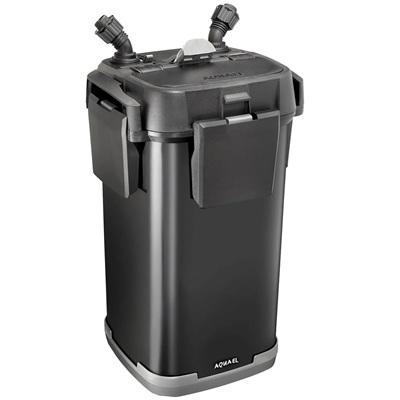
Aquael Ultramax (1000 / 1500 / 2000)
A tank from a 40 up to a 185 where an FX is too tall for the cabinet: three sizes, a pre-filter in the lid, and more media per watt than anything else here.
- Priming
- Push-button
- Pre-filter
- Separate, rinse without opening
- Heater
- No
- Noise
- —
- Hoses
- 16/22 mm
- Sizes
- 264 GPH–528 GPH
- Runs on
- 15–24 W · $24–$38 a year
- Street price
- $195–300 (2026-08)
| Size | Box says | Really moves | Media | Physics · a year |
|---|---|---|---|---|
| Ultramax 1000 · 264 GPH · 15 W → | 25–80 gal | 145 GPH (est.) | 5.7 L | 37–65 gal freshwater · 20–37 gal planted · $24/yr |
| Ultramax 1500 · 396 GPH · 16 W → | 65–120 gal | 218 GPH (est.) | 7.6 L | 55–90 gal freshwater · 29–40 gal planted · $25/yr |
| Ultramax 2000 · 528 GPH · 24 W → | 105–185 gal | 291 GPH (est.) | 9.5 L | 65–125 gal freshwater · 40–65 gal planted · $38/yr |
"Box says" is Aquael's own tank rating where we could read it (source: Aquael's own ULTRAMAX spec table and Bulk Reef Supply listings, re-checked 30 Aug 2026); the size links go where the button below does. "Really moves" is the maker's published circulation figure or, marked est., 55 % of the rating. The last column is the standard tanks the rating is right for at 4–6× (freshwater) and 8–10× (planted), moderately stocked, and what a year costs at $0.18/kWh.
- The most media per watt on this page: the 2000 holds 9.5 L on 24 W, where an FX6 holds 5.9 L on 41 W.
- Three, four and five 1.9 L baskets across the line, plus a pre-filter sponge in the lid you can rinse without opening the canister — the Oase trick at a lower price.
- A priming pump in the lid, dual ball valves on both hoses, and a shorter body than an FX of the same flow.
- A smaller dealer network in the US than Fluval or Eheim: spares mean ordering, not walking into a shop.
- Aquael's stated media is per basket; the 9.5 L on the 2000 is five baskets — the 16 L "container volume" on the box includes the pump head and the water.
- Aquael publishes no filter-circulation figure, so the "really moves" column below is this site's 55 % estimate rather than the maker's own number, and it is likely conservative.
- The low end of each rating is real: on a 55 gallon the 2000 is too much filter, and the 1000 is the size for it.
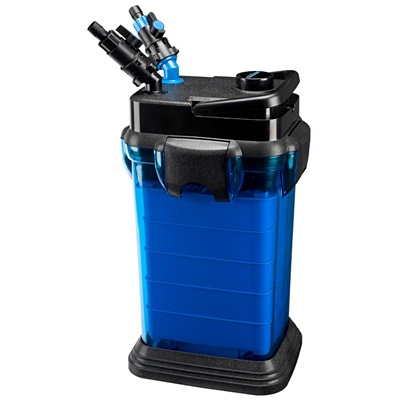
Penn-Plax Cascade (500 / 700 / 1000 / 1200 / 1500)
A freshwater tank on a budget, bought a size or two up from what the box claims — these are the most generous ratings in the comparison, and the physics column below is the one to buy on.
- Priming
- Push-button
- Pre-filter
- No
- Heater
- No
- Noise
- —
- Hoses
- 16/22 mm
- Sizes
- 115 GPH–350 GPH
- Runs on
- 10.5–45.5 W · $17–$72 a year
- Street price
- $105–170 (2026-08)
| Size | Box says | Really moves | Media | Physics · a year |
|---|---|---|---|---|
| Cascade 500 · 115 GPH · 10.5 W → | up to 30 gal | 63 GPH (est.) | 2.2 L est. | 15–29 gal freshwater · 10–15 gal planted · $17/yr |
| Cascade 700 · 185 GPH · 25 W → | up to 65 gal | 102 GPH (est.) | 3.5 L est. | 29–40 gal freshwater · 15–20 gal planted · $39/yr |
| Cascade 1000 · 265 GPH · 30 W → | up to 100 gal | 146 GPH (est.) | 5 L est. | 37–65 gal freshwater · 20–37 gal planted · $47/yr |
| Cascade 1200 · 315 GPH · 45.5 W → | up to 150 gal | 173 GPH (est.) | 6 L est. | 40–75 gal freshwater · 29–37 gal planted · $72/yr |
| Cascade 1500 · 350 GPH · 45.5 W → | up to 200 gal | 193 GPH (est.) | 6.6 L est. | 40–90 gal freshwater · 29–40 gal planted · $72/yr |
"Box says" is Penn-Plax's own tank rating where we could read it (source: Penn-Plax product listings and retailer pages, re-checked 30 Aug 2026); the size links go where the button below does. "Really moves" is the maker's published circulation figure or, marked est., 55 % of the rating. The last column is the standard tanks the rating is right for at 4–6× (freshwater) and 8–10× (planted), moderately stocked, and what a year costs at $0.18/kWh.
- The widest size ladder here — five canisters from a 30 gallon rating to a 200 — with a push-button primer and 360° valve taps that swivel into a tight cabinet.
- The cheapest way into a canister filter: the 500 and 700 undercut everything else on this page.
- Two to five stacking baskets depending on size, and a tip-proof base.
- The most generous ratings in this comparison at every size — "up to 200 gallons" on a 350 GPH pump — and the physics column puts each one at roughly half the box.
- The line fills the bottom of the running-cost table below: the 1200 moves less water per watt than anything else on this page, and it and the 1500 both draw 45.5 W — about $72 a year each, twice what an Eheim 2217 costs to run.
- No published circulation figure and no stated media volume anywhere in the line, so the "really moves" and media columns below are the engine's estimates rather than the maker's numbers.
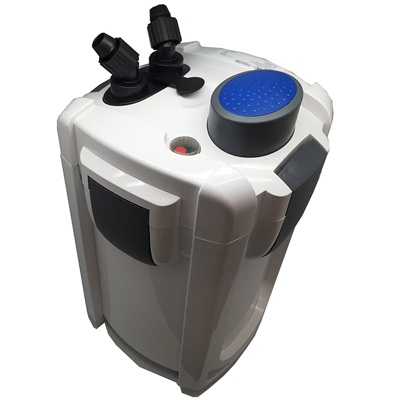
SunSun HW-704B
A big tank on a small budget, run with a spare seal and impeller in the drawer — more than twice an FX4's media for about a third of the price.
- Priming
- Push-button
- Pre-filter
- No
- Heater
- No
- Noise
- —
- Hoses
- 16/22 mm
- Sizes
- 525 GPH
- Runs on
- 45 W · $71 a year
- Street price
- $100–140 (2026-08)
| Size | Box says | Really moves | Media | Physics · a year |
|---|---|---|---|---|
| HW-704B · 525 GPH · 45 W → | up to 150 gal | 289 GPH (est.) | 9 L | 65–125 gal freshwater · 40–65 gal planted · $71/yr |
"Box says" is SunSun's own tank rating where we could read it (source: Retailer listings and the Amazon size-comparison table, re-checked 30 Aug 2026); the size links go where the button below does. "Really moves" is the maker's published circulation figure or, marked est., 55 % of the rating. The last column is the standard tanks the rating is right for at 4–6× (freshwater) and 8–10× (planted), moderately stocked, and what a year costs at $0.18/kWh.
- About 9 L of media across four trays for the price of a small-tank Fluval — more than any filter here except the Aquael 2000.
- A 9 W UV lamp built in, which is worth something against green water and nothing against ich.
- The 700 series is the one to buy: the same 525 GPH as the older HW-304B on 45 W instead of 55, and a UV safety sensor the 300 series does not have.
- Still one of the three dearest filters here to run — about $71 a year, because it moves a lot of water — and it sits in the bottom third of the page for flow per watt, even though it is no longer the worst.
- SunSun's model numbers are a maze: the last digit is the size (2, 3 and 4 are roughly 264, 370 and 525 GPH) and the first digit is the generation, so an HW-302, HW-402B and HW-702B are three versions of the same small filter. The plain HW-302 is the only one with no UV lamp, and the 70x series adds the safety sensor and, on the two larger sizes, cuts the draw — 30 W against the 303B's 35, and 45 against the 304B's 55.
- Sellers disagree about what it is rated for — the same HW-704B is listed as 125, 150 and 200 gallons — which is the clearest reason to read the physics column rather than the box.
- Reviewers report impeller wear inside two years; the motor tolerances are plastic-on-plastic where Eheim uses ceramic. The previous HW-304B measured 57 dB, the loudest tested in this group; nobody has published a measurement of this quieter-pumped version.
- Rebadged under several names (Polar Aurora, Aquatop, CNZ). Buy from a seller that stocks the seals.
How big a canister filter do I need?
Rated flow of 4–6 times the tank's water volume an hour for a freshwater community, 8–10 for a planted tank — on the box-rating basis, because that is the basis the rules were written against. Those rules already have the media loss baked in; apply them to a real-flow figure and you buy a filter two sizes too big. The trap is the other number on the box. "Up to 200 gallons" on the Cascade 1500 is printed beside a 350 GPH pump; at 4–6× that pump is a 40 to 90 gallon filter, and on a 200 it turns the water over 1.7× an hour on paper and 0.9× for real. Eheim's "up to 66 gal" on the 2213's 440 L/h pump is the same generosity from a better maker: physics says 15–29 gal. Oase's "up to 160 gal" for the Thermo 600 is a rating for a lightly stocked tank; moderately stocked, it is 40–75 gal.
The rule has a top as well as a bottom: a rating more than half again over the top of the range is graded "high", and the low end of each range here is the first tank where the filter is no longer overkill. Overkill is not dangerous the way an oversized heater is — it is money, noise and a spray bar to tame the current — but the Fluval 407's box says "from 50 gallons" and the physics says a 40 breeder would find it too much, so the range starts at the 55. The calculator grades any filter you type in the same way.
Rated flow vs real flow: what the box number really moves
The rating is measured at the pump, with nothing in the baskets and no hose. Add media, an intake strainer and two lengths of hose and the flow that reaches the tank is about half to two thirds of it. Nobody has to take that on trust: Fluval prints both numbers on the spec sheet — "pump output" and "filter circulation" — and the ratio between them on every Fluval model here is 59–72 %. The calculator's engine assumes 55 %, which makes it the conservative estimate, and that is the figure used below for the makers that publish only the pump number.
Half the reviews knock 30–40 % off the rating "for head pressure," and it is the wrong reason. A canister under the tank is a closed loop: the intake siphon pushes the pump inlet by exactly the height the outlet has to lift, so the stand height cancels. The derate tables belong to sump return pumps, which lift to an open surface. What costs a canister flow is the media it is pushing water through and the hose it is pushing it along — which is why a filter on a long run to a cabinet two rooms over genuinely loses flow, and one under the tank on a tall stand does not.
How much media does each one hold?
Several makers publish two numbers: the volume of the whole canister and the volume its baskets actually hold. They are not close. The Fluval FX4 is a 14 L canister holding 3.9 L of media — 28 % — because the rest is pump head, the space around the baskets and water. The Eheim 2217 is a single chamber with no baskets: 6 L in a 6.6 L body, 91 %. Quote one maker's canister volume against another's media volume and you will conclude the opposite of the truth, which is exactly what this page did until a reader caught it. Every media figure on this page is the media.
| Model | Canister | Media | Actually media |
|---|---|---|---|
| Eheim 2217 | 6.6 L | 6 L | 91 % |
| Eheim 2213 | 3.5 L | 3 L | 86 % |
| Eheim 2215 | 4.8 L | 4 L | 83 % |
| Eheim 2211 | 1.3 L | 1 L | 77 % |
| Aquael Ultramax 2000 | 16 L | 9.5 L | 59 % |
| Fluval FX2 | 9.5 L | 3.9 L | 41 % |
| Fluval FX6 | 20 L | 5.9 L | 30 % |
| Fluval FX4 | 14 L | 3.9 L | 28 % |
The models whose makers publish both volumes, computed by this site's engine. Sources are on each product card. Where a maker publishes only one number, it is the media volume and the card says so.
This is the spec that decides how much fish the filter can carry, and the one the box is quietest about. A filter's biological capacity is the surface area its bacteria live on; the water only has to pass over it often enough, and above a few turnovers an hour more flow adds almost nothing — about 9 % for doubling it. So the Eheim 2217, with a 1,000 L/h pump and 6 L of media, out-carries a Fluval 407 with a 1,450 L/h pump and 4.2 L, and on a 65 gallon tank that is 2.5 % of the water volume in media against 1.7 %. And the FX6 — the biggest canister on this page — holds 5.9 L, near enough what the 2217 holds on a pump 3.5 times the size: what an FX buys you is mechanical area and turnover for large, messy fish, not biological volume. Where a maker does not state the volume, the tables estimate it at 5 mL per L/h of rating and mark it "est." That figure is the middle of a wide spread rather than a law — the published canisters here run from 1.5 to 6.8 mL per L/h, and 8 of 16 sit within 15 % of it — so treat an estimated media figure as a bracket, not a measurement. Inside a line where one size is stated the siblings follow that size's own ratio instead: Fluval's 407 holds 4.2 L on 1,450 L/h, so its 107, 207 and 307 are estimated at 2.9 mL per L/h, not the generic five.
What a canister filter costs to run
A canister runs every hour of the year, so its wattage is a bill. At $0.18 a kilowatt-hour, the 45 W SunSun costs $71 a year and the 24 W Aquael with the same 2,000 L/h rating costs $38 — $166 over five years. The SunSun is about $128 cheaper to buy, so the cheaper filter has spent the difference and more before the five years are up. The honest efficiency figure is real liters per hour per watt:
| Filter | Draw | Really moves | Real L/h per W | A year |
|---|---|---|---|---|
| Fluval FX4 | 30 W | 449 GPH | 57 | $47 |
| Fluval FX6 | 41 W | 563 GPH | 52 | $65 |
| Aquael Ultramax 1500 | 16 W | 218 GPH | 52 | $25 |
| Fluval 307 | 16 W | 206 GPH | 49 | $25 |
| Fluval FX2 | 27 W | 343 GPH | 48 | $43 |
| Fluval 207 | 10 W | 122 GPH | 46 | $16 |
| Aquael Ultramax 2000 | 24 W | 291 GPH | 46 | $38 |
| Fluval 407 | 23 W | 246 GPH | 40 | $36 |
| Oase Thermo 350 | 16 W | 160 GPH | 38 | $25 |
| Aquael Ultramax 1000 | 15 W | 145 GPH | 37 | $24 |
| Fluval 107 | 10 W | 95 GPH | 36 | $16 |
| Oase Thermo 250 | 15 W | 131 GPH | 33 | $24 |
| Oase Thermo 850 | 25 W | 218 GPH | 33 | $39 |
| Eheim 2211 | 5 W | 44 GPH | 33 | $7.89 |
| Eheim 2213 | 8 W | 64 GPH | 30 | $13 |
| Oase Thermo 600 | 23 W | 182 GPH | 30 | $36 |
| Eheim 2217 | 20 W | 145 GPH | 28 | $32 |
| SunSun HW-704B | 45 W | 289 GPH | 24 | $71 |
| Penn-Plax Cascade 500 | 10.5 W | 63 GPH | 23 | $17 |
| Eheim 2215 | 15 W | 90 GPH | 23 | $24 |
| Penn-Plax Cascade 1000 | 30 W | 146 GPH | 18 | $47 |
| Penn-Plax Cascade 1500 | 45.5 W | 193 GPH | 16 | $72 |
| Penn-Plax Cascade 700 | 25 W | 102 GPH | 15 | $39 |
| Penn-Plax Cascade 1200 | 45.5 W | 173 GPH | 14 | $72 |
Real flow as above; cost at $0.18/kWh, 24 h a day, 365 days. Your rate and the rest of the tank's draw go through the electricity cost calculator. The FX6 tops the draw at 41 W and still lands mid-table on efficiency because it moves so much water; the 1990s-design pumps at the bottom are the ones to notice.
How canister filters fail
- The lid seal. A canister is a pressurized box under your tank, and the O-ring on the lid is the part that keeps the water in it. It dries and flattens; it gets a grain of gravel across it on reassembly; on a cheap filter it is not sold separately. A slow seep here empties a tank onto the floor over a weekend. Grease it with silicone lubricant at every cleaning and buy the spare before you need it.
- Hose clamps and trimmed hoses. The second leak point. Ribbed Fluval hose cut short and forced onto a barb will weep at the clamp; every hose end wants an inch of slack.
- Losing prime. A power cut, a water change that drops the intake below the surface, or air drawn in at a loose fitting, and the pump spins in air. Self-priming pumps restart; a manual-prime Eheim needs you. Air in a running canister also rattles, which is most of the "my filter is noisy" threads.
- Impeller and shaft wear. A ceramic shaft (Eheim, Oase) wears for decades; a plastic-on-plastic assembly rattles inside two years, and one review measured exactly that on the SunSun. Impellers are a wear part on all of them — the question is whether one is $8 and in stock.
- The dead-canister crash. The failure the box never mentions: a canister that stops for a day — power, a stuck impeller, a kink — is a sealed box of decaying waste with no oxygen, and restarting it pumps that into the tank. After any stoppage over a few hours, open it and rinse before you plug it back in.
One canister or two?
Two, from about 75 gallons — not for flow, which one big filter can supply, but because two filters let you clean one while the other keeps the colony, let one carry the tank while the other is off for repair, and put an outlet at each end of a long tank. On a 125, two Fluval 307s hold about as much media as one 407 and cost a little more; on a 180, two Eheim 2217s hold 12 L against an FX6's 6, draw 40 W against 41, and one of them is never off. The FX line wins on one box, one set of hoses and one thing to prime; the pair wins on redundancy. The calculator flags the size at which it advises two.
What we'd skip
- Buying by the gallon rating. The one number on the box that is scaled to nothing. Buy by the flow rating against the turnover rule, and read the media volume.
- Canisters with a UV lamp in the body. The lamp is a few watts at the wrong flow to do anything to parasites; it will clear green water and little else, and it complicates the seal. A separate UV unit sized to its job does the job.
- A filter with no spares network. Rebadged imports are fine value while the seal holds. Before buying one, find the replacement O-ring and impeller on sale somewhere; if you cannot, the filter's life is the seal's life.
- Sizing a canister from a real-flow number. The turnover rules already allow for the media loss. Apply 4–6× to a measured figure and you are two sizes over.
- A canister as a reef's filtration. It works on a fish- only marine tank. On a reef, a sump and a skimmer do what a sealed box of media cannot, and the return pump gets sized by its curve, not a turnover rule.
Common questions
How often should I clean a canister filter?
When the flow drops visibly, not on a calendar — typically every four to eight weeks for the mechanical stage and every few months for the biological media, rinsed in tank water rather than tap water so the chlorine does not kill the colony. A pre-filter you can pull without opening the canister (the Oase, the Aquael) turns the frequent job into a two-minute one; on a single-chamber Eheim the same job means opening the whole thing, which is the honest cost of its simplicity.
Is a canister worth it on a 20 or 29 gallon tank?
A 107 or 207 on a 20 is quieter and holds far more media than any hang-on-back, and it takes the hardware out of the tank. It is also two to three times the price of a good HOB, and on a lightly stocked 20 the HOB is genuinely adequate. The honest split: a canister earns its price on a planted tank (where the 8–10× turnover is hard to reach otherwise), a messy fish, or a rimless tank where a HOB spoils the look. The filter size calculator compares the two on the same basis.
Can I use a canister filter on a saltwater or reef tank?
On a fish-only marine tank, yes — the Oase and the Eheim are both rated for it, and a canister packed with biological media does the same job it does in fresh water. On a reef, most keepers run a sump instead: a canister that goes a few weeks between cleanings becomes a nitrate factory, and the sump gives you somewhere to put a skimmer, a heater and a refugium. If you go that way, the return pump sizing calculator does the pump-curve arithmetic a canister never needs.