Links marked See on Amazon are affiliate links — buy through one and we earn a commission at no cost to you. How that works, and how the picks are made.
For most reef sumps, a Sicce Syncra SDC at the size the table below gives: the quietest by consensus, a five-year warranty, and a head figure that keeps its flow up a tall stand. On a budget, a Jebao DCP one size up from what the table says, with a second one in the cupboard. For a basement sump or a long run, an EcoTech Vectra — the head, not the flow, is what you are paying for. For a 120 to 250, the Reef Octopus VarioS 8 moves more than an SDC 9.0 and needs no app to do it. And on any of them, buy DC and turn it down: a pump delivering 2,000 L/h on our reference run draws 12 W as a DC pump at 51 % speed and 80 W as an AC pump behind a valve.
A return pump's box prints two numbers — the flow at zero head and the head at zero flow — and the pump never runs at either. It delivers where its curve meets the plumbing's, and the plumbing's curve is the static lift plus friction that rises as the flow squared. The reviews rank pumps by the first number and subtract "10 % per foot" for the second, which on our reference run predicts 9 % of the rating for a Sicce SDC 7.0; the curve delivers 67 %. Every figure below is that arithmetic — the return pump calculator's engine — run on one reference sump: 1.2 m of lift, 1 in PVC, 3 m of pipe, two elbows and a ball valve, ending in loc-line. Your run goes through the calculator.
Which return pump for your tank
For a display of each size with a sump holding 25 % of it, the smallest DC pump that delivers 7.5× turnover on the reference run at no more than 85 % speed — headroom for a colder day and a dirtier impeller — and the speed, watts and yearly cost it actually runs at to do it. "Best value" ranges over every DC pump here; "best overall" only over the lines with a warranty and a spares network.
| Display | System water | Best value | Runs at | Best overall | Runs at |
|---|---|---|---|---|---|
| 40 gallon breeder | 199 L | Hygger 800 GPH | 84 % · 15 W · $23/yr | Reef Octopus VarioS 4 | 67 % · 12 W · $19/yr |
| 55 gallon | 256 L | Jebao / Jecod DCP-4000 | 77 % · 15 W · $23/yr | Reef Octopus VarioS 4 | 75 % · 17 W · $26/yr |
| 75 gallon | 354 L | Jebao / Jecod DCP-5000 | 84 % · 24 W · $38/yr | Sicce SDC 6.0 | 85 % · 31 W · $48/yr |
| 90 gallon | 407 L | Jebao / Jecod DCP-6500 | 80 % · 28 W · $44/yr | Reef Octopus VarioS 6 | 78 % · 33 W · $52/yr |
| 120 gallon | 543 L | Hygger 2120 GPH | 83 % · 37 W · $58/yr | Neptune Systems COR-20 | 82 % · 50 W · $78/yr |
| 150 gallon | 717 L | EcoTech L2 | 83 % · 86 W · $135/yr | EcoTech L2 | 83 % · 86 W · $135/yr |
| 180 gallon | 850 L | EcoTech L2 | 94 % · 125 W · $198/yr | EcoTech L2 | 94 % · 125 W · $198/yr |
| 210 gallon | 991 L | EcoTech L2 | flat out · 6.9× | EcoTech L2 | flat out · 6.9× |
Standard display sizes filled to an inch under the rim, plus a sump at 25 %; the reference plumbing above; DC draw by the affinity law (speed cubed) at $0.18/kWh. Amazon links are affiliate links; the specialist-retailer links earn us nothing. Your own lift and pipe go through the calculator.
At a glance
| Pump | Type | Sizes | Head | Warranty | Control | Street price |
|---|---|---|---|---|---|---|
| Sicce Syncra SDC (3.0 / 6.0 / 7.0 / 9.0) | DC | 800 GPH–2,500 GPH | 7.5 ft–23 ft | 5 yr | Controller + Wi-Fi app | $300–550 |
| EcoTech Vectra 2 (S2 / M2 / L2) | DC | 1,400 GPH–3,100 GPH | 11.5 ft–21.5 ft | 1 yr | Mobius app over Bluetooth | $400–600 |
| Reef Octopus VarioS (4 / 6 / 8) | DC | 1,056 GPH–2,700 GPH | 14.7 ft–18 ft | 5 yr | Controller with 0–10 V input | $400–580 |
| Neptune Systems COR (15 / 20) | DC | 1,500 GPH–2,000 GPH | 14 ft–20 ft | 1 yr | Apex 1LINK, or a standalone power supply and app | $420–470 |
| Jebao / Jecod DCP (2500 / 4000 / 5000 / 6500 / 10000) | DC | 660 GPH–2,642 GPH | 8.2 ft–19.7 ft | 1 yr | Controller with 10 speeds and feed mode | $60–135 |
| Hygger DC return pump (800 to 2,650 GPH) | DC | 800 GPH–2,650 GPH | 9.8 ft–19.7 ft | 1 yr | Controller, 30–100 % in steps | $60–90 |
| Eheim compactON 3000 | AC | 793 GPH | 8.8 ft | 3 yr | None: a plug. Throttle with a valve on the outlet | $130–155 |
| Sicce Syncra Silent 4.0 | AC | 951 GPH | 12.6 ft | 5 yr | None: a plug. Throttle with a valve on the outlet | $180–200 |
From each maker's page or a specialist retailer's listing, checked on the date at the top. Prices are broad bands from specialist retailers, not Amazon.
How we ranked them
Three things, in this order. What it delivers — from the curve, at real heads, because two pumps with the same GPH and different head figures are different pumps on a tall stand. What it is like to own — the warranty, because a DC pump is three parts (motor, controller, power supply) and two of them fail first; noise, by the reef forums' consensus; and whether it runs in-line. Then the ordinary things: app or dial, feed mode, price. Price bands are from specialist retailers on the date at the top; commission is not a factor, and about half the links on this page earn us nothing because the reef specialists are where these pumps are sold.
The picks
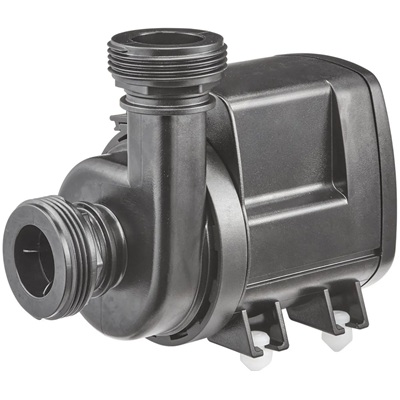
Sicce Syncra SDC (3.0 / 6.0 / 7.0 / 9.0)
The sump under most reef tanks, now from a nano up to 200 gallons: the quietest pump in this group by consensus, a five-year warranty, and a curve that keeps its flow at real heads.
- Type
- DC, variable speed
- Control
- Controller + Wi-Fi app; 0–10 V input for Apex
- Warranty
- 5 years
- In-line
- Yes, or submerged
- Sizes
- 800 GPH–2,500 GPH
- Head
- 7.5 ft–23 ft
- Draw
- 35–90 W flat out
- Street price
- $300–550 (2026-08)
| Size | Box says | Delivers at head | On the reference run | Right for · a year |
|---|---|---|---|---|
| SDC 3.0 · 35 W → | 800 GPH · 7.5 ft head | 1 m: 600 GPH · 2 m: 283 GPH · 3 m: 0 GPH | 484 GPH (60 % of rating) | 29–75 gal · turned down for 5.5–20 gal · $55/yr flat out |
| SDC 6.0 · 50 W → | 1,450 GPH · 11.5 ft head | 1 m: 1,226 GPH · 2 m: 950 GPH · 3 m: 550 GPH | 929 GPH (64 % of rating) | 55–125 gal · turned down for 5.5–40 gal · $79/yr flat out |
| SDC 7.0 · 65 W → | 1,900 GPH · 16.5 ft head | 1 m: 1,701 GPH · 2 m: 1,475 GPH · 3 m: 1,207 GPH | 1,273 GPH (67 % of rating) | 75–180 gal · turned down for 5.5–65 gal · $103/yr flat out |
| SDC 9.0 · 90 W → | 2,500 GPH · 23 ft head | 1 m: 2,315 GPH · 2 m: 2,114 GPH · 3 m: 1,891 GPH | 1,676 GPH (67 % of rating) | 120–210 gal · turned down for 5.5–90 gal · $142/yr flat out |
"Box says" is the maker's zero-head flow and shut-off head (source: Bulk Reef Supply listings, re-checked 30 Aug 2026); the size links go where the button below does. "Delivers at head" is the curve through those two numbers at 1, 2 and 3 m. "On the reference run" is the operating point on 1.2 m of lift, 1 in PVC, 3 m, two elbows, a ball valve and loc-line. "Right for" is the standard displays (plus a 25 % sump) it reaches 5–10× on at full speed, and the tanks it would need turning well down for; the year is at full draw, $0.18/kWh.
- A five-year warranty on a DC pump — the longest here by a distance, and the thing that separates it from pumps with the same numbers.
- The steep head figures (16.5 ft on the 7.0) mean it loses less of its flow to a tall stand than anything but the Vectra.
- Runs in the sump or in-line, and the controller takes a 0–10 V lead from an Apex.
- The Wi-Fi app is the weak point — reviewers rate the pump and tolerate the software.
- Dearer than a Jebao with the same numbers by two to three times; you are paying for the warranty and the quiet.
- Three parts to fail — motor, controller, power supply — like every DC pump.
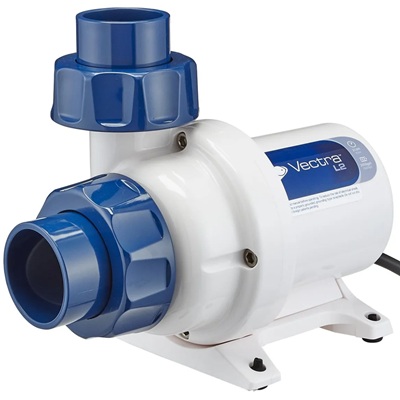
EcoTech Vectra 2 (S2 / M2 / L2)
A return that has to climb: a basement sump, a tank on a tall stand, a long run to a frag tank — anywhere the head, not the flow, is the problem.
- Type
- DC, variable speed
- Control
- Mobius app over Bluetooth; auto-calibration to the plumbing
- Warranty
- 1 year
- In-line
- Yes, or submerged
- Sizes
- 1,400 GPH–3,100 GPH
- Head
- 11.5 ft–21.5 ft
- Draw
- 72–150 W flat out
- Street price
- $400–600 (2026-08)
| Size | Box says | Delivers at head | On the reference run | Right for · a year |
|---|---|---|---|---|
| S2 · 72 W → | 1,400 GPH · 11.5 ft head | 1 m: 1,184 GPH · 2 m: 917 GPH · 3 m: 532 GPH | 909 GPH (65 % of rating) | 55–125 gal · turned down for 5.5–40 gal · $114/yr flat out |
| M2 · 96 W → | 2,000 GPH · 21.5 ft head | 1 m: 1,841 GPH · 2 m: 1,667 GPH · 3 m: 1,473 GPH | 1,435 GPH (72 % of rating) | 90–210 gal · turned down for 5.5–75 gal · $151/yr flat out |
| L2 · 150 W → | 3,100 GPH · 21.5 ft head | 1 m: 2,854 GPH · 2 m: 2,584 GPH · 3 m: 2,283 GPH | 1,818 GPH (59 % of rating) | 120–210 gal · turned down for 5.5–90 gal · $237/yr flat out |
"Box says" is the maker's zero-head flow and shut-off head (source: EcoTech Marine and Bulk Reef Supply listings, re-checked 30 Aug 2026); the size links go where the button below does. "Delivers at head" is the curve through those two numbers at 1, 2 and 3 m. "On the reference run" is the operating point on 1.2 m of lift, 1 in PVC, 3 m, two elbows, a ball valve and loc-line. "Right for" is the standard displays (plus a 25 % sump) it reaches 5–10× on at full speed, and the tanks it would need turning well down for; the year is at full draw, $0.18/kWh.
- 21.5 ft of head on the M2 and L2, the highest in this comparison, so the curve barely droops at the heads a sump actually sees.
- Auto-calibration: the pump learns the plumbing and holds a set flow rather than a set speed.
- In-line or submerged, and the Mobius app is the best of the bunch.
- A one-year warranty on the dearest pumps here; the reef forums are not kind about that.
- The S2 carries a 72 W supply for 1,400 GPH — the M2 delivers more per watt.
- Not on Amazon at sensible prices; we link the specialist retailers and earn nothing.
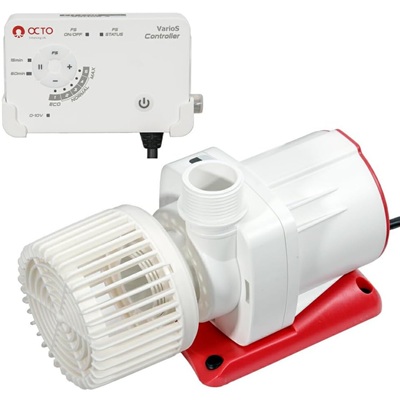
Reef Octopus VarioS (4 / 6 / 8)
A 120 to 250 gallon reef for anyone who does not want a phone in the loop: big flow, respectable head, and a controller that is a dial, a feed button and a 0–10 V socket for a controller you already own.
- Type
- DC, variable speed
- Control
- Controller with 0–10 V input; feed mode
- Warranty
- 5 years
- In-line
- Yes, or submerged
- Sizes
- 1,056 GPH–2,700 GPH
- Head
- 14.7 ft–18 ft
- Draw
- 40–98 W flat out
- Street price
- $400–580 (2026-08)
| Size | Box says | Delivers at head | On the reference run | Right for · a year |
|---|---|---|---|---|
| VarioS 4 · 40 W → | 1,056 GPH · 14.7 ft head | 1 m: 931 GPH · 2 m: 786 GPH · 3 m: 607 GPH | 807 GPH (76 % of rating) | 55–125 gal · turned down for 5.5–40 gal · $63/yr flat out |
| VarioS 6 · 70 W → | 1,720 GPH · 16 ft head | 1 m: 1,534 GPH · 2 m: 1,321 GPH · 3 m: 1,067 GPH | 1,183 GPH (69 % of rating) | 65–180 gal · turned down for 5.5–55 gal · $110/yr flat out |
| VarioS 8 · 98 W → | 2,700 GPH · 18 ft head | 1 m: 2,442 GPH · 2 m: 2,152 GPH · 3 m: 1,818 GPH | 1,586 GPH (59 % of rating) | 90–210 gal · turned down for 5.5–75 gal · $155/yr flat out |
"Box says" is the maker's zero-head flow and shut-off head (source: Reef Octopus and retailer listings, re-checked 31 Aug 2026); the size links go where the button below does. "Delivers at head" is the curve through those two numbers at 1, 2 and 3 m. "On the reference run" is the operating point on 1.2 m of lift, 1 in PVC, 3 m, two elbows, a ball valve and loc-line. "Right for" is the standard displays (plus a 25 % sump) it reaches 5–10× on at full speed, and the tanks it would need turning well down for; the year is at full draw, $0.18/kWh.
- The VarioS 8 moves 2,700 GPH — more than any Sicce — at a head that still clears a tall stand.
- The only premium DC pump here with no app in the way: a dial, a feed button and a 0–10 V input, so an Apex drives it and nothing needs updating.
- Sold through every reef specialist; parts are easy.
- The five years covers the pump body only — the controller is three and the power adapter one, and on a DC pump the controller is the part that fails.
- The 98 W draw of the 8 is second only to the Vectra L2 at full speed; run it turned down.
- These are on Amazon, but Reef Octopus warrants only units "purchased from HONYA CO., LTD through our Official Authorised Dealers", and the marketplace listings are third-party sellers. The links here go to authorized specialists and earn us nothing, because a cheaper listing that voids the five-year warranty is not cheaper.
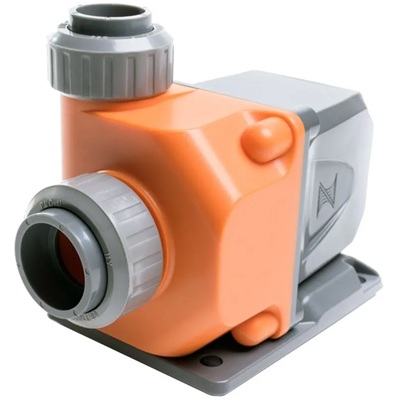
Neptune Systems COR (15 / 20)
A tank already on an Apex, where the pump reports its own flow and power to the controller and follows the feed and maintenance modes without another box.
- Type
- DC, variable speed
- Control
- Apex 1LINK, or a standalone power supply and app
- Warranty
- 1 year
- In-line
- Yes, or submerged
- Sizes
- 1,500 GPH–2,000 GPH
- Head
- 14 ft–20 ft
- Draw
- 50–90 W flat out
- Street price
- $420–470 (2026-08)
| Size | Box says | Delivers at head | On the reference run | Right for · a year |
|---|---|---|---|---|
| COR-15 · 50 W → | 1,500 GPH · 14 ft head | 1 m: 1,313 GPH · 2 m: 1,093 GPH · 3 m: 817 GPH | 1,030 GPH (69 % of rating) | 65–150 gal · turned down for 5.5–55 gal · $79/yr flat out |
| COR-20 · 90 W → | 2,000 GPH · 20 ft head | 1 m: 1,829 GPH · 2 m: 1,639 GPH · 3 m: 1,425 GPH | 1,403 GPH (70 % of rating) | 90–210 gal · turned down for 5.5–75 gal · $142/yr flat out |
"Box says" is the maker's zero-head flow and shut-off head (source: Neptune Systems and Bulk Reef Supply listings, re-checked 31 Aug 2026); the size links go where the button below does. "Delivers at head" is the curve through those two numbers at 1, 2 and 3 m. "On the reference run" is the operating point on 1.2 m of lift, 1 in PVC, 3 m, two elbows, a ball valve and loc-line. "Right for" is the standard displays (plus a 25 % sump) it reaches 5–10× on at full speed, and the tanks it would need turning well down for; the year is at full draw, $0.18/kWh.
- The COR-15 delivers 1,500 GPH on under 50 W, and the COR-20 2,000 GPH at 20 ft of head — a genuinely flat curve at the heads a sump sees.
- Talks to the Apex directly: flow, power and alarms on the same dashboard as everything else.
- Runs in-line or submerged.
- Without an Apex you buy the standalone supply, and the value case gets thinner.
- A one-year warranty.
- Only two sizes; nothing under 1,500 GPH.
Jebao / Jecod DCP (2500 / 4000 / 5000 / 6500 / 10000)
A first sump, a quarantine system, or anyone who would rather buy two Jebaos and keep one in the cupboard than one Sicce — with eyes open about the head figures.
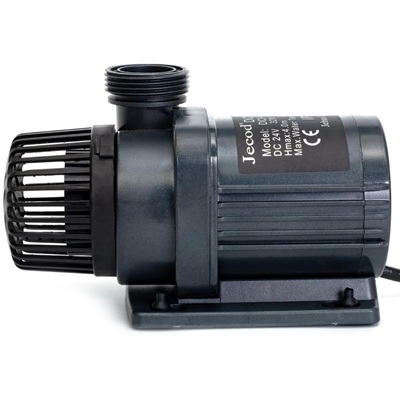
- Type
- DC, variable speed
- Control
- Controller with 10 speeds and feed mode
- Warranty
- 1 year
- In-line
- Yes, or submerged
- Sizes
- 660 GPH–2,642 GPH
- Head
- 8.2 ft–19.7 ft
- Draw
- 23–80 W flat out
- Street price
- $60–135 (2026-08)
| Size | Box says | Delivers at head | On the reference run | Right for · a year |
|---|---|---|---|---|
| DCP-2500 · 23 W → | 660 GPH · 8.2 ft head | 1 m: 512 GPH · 2 m: 295 GPH · 3 m: 0 GPH | 437 GPH (66 % of rating) | 29–65 gal · turned down for 5.5–20 gal · $36/yr flat out |
| DCP-4000 · 32 W → | 1,057 GPH · 13.1 ft head | 1 m: 915 GPH · 2 m: 747 GPH · 3 m: 528 GPH | 780 GPH (74 % of rating) | 40–125 gal · turned down for 5.5–37 gal · $50/yr flat out |
| DCP-5000 · 40 W → | 1,321 GPH · 13.1 ft head | 1 m: 1,144 GPH · 2 m: 934 GPH · 3 m: 660 GPH | 922 GPH (70 % of rating) | 55–125 gal · turned down for 5.5–40 gal · $63/yr flat out |
| DCP-6500 · 55 W → | 1,717 GPH · 14.8 ft head | 1 m: 1,514 GPH · 2 m: 1,280 GPH · 3 m: 991 GPH | 1,147 GPH (67 % of rating) | 65–180 gal · turned down for 5.5–55 gal · $87/yr flat out |
| DCP-10000 · 80 W → | 2,642 GPH · 19.7 ft head | 1 m: 2,412 GPH · 2 m: 2,157 GPH · 3 m: 1,868 GPH | 1,629 GPH (62 % of rating) | 120–210 gal · turned down for 5.5–90 gal · $126/yr flat out |
"Box says" is the maker's zero-head flow and shut-off head (source: Jebao DCP owner's manual via D-D The Aquarium Solution, re-read 31 Aug 2026 — its own table gives flow, head and watts for the whole range); the size links go where the button below does. "Delivers at head" is the curve through those two numbers at 1, 2 and 3 m. "On the reference run" is the operating point on 1.2 m of lift, 1 in PVC, 3 m, two elbows, a ball valve and loc-line. "Right for" is the standard displays (plus a 25 % sump) it reaches 5–10× on at full speed, and the tanks it would need turning well down for; the year is at full draw, $0.18/kWh.
- A third of the price of the premium pumps for the same box numbers, and the sine-wave DCP generation is genuinely quiet.
- Ten speed steps and a feed mode on a plain controller.
- Cheap enough that the honest strategy — a spare on the shelf — costs less than one premium pump.
- The head figures are the lowest here for the flow — 2.5 m on the 2500, 4 m on the 4000 — so it loses more of its rating to a tall stand than anything else on this page, and the tables below show how much.
- One-year warranty, and the controller and power supply are the parts that go.
- Model names churn (DCT, DCP, DCS, EP) and the range differs by seller: the manual lists a DCP-3000, 8000 and 18000 that the US listings do not, and the listings sell a DCP-3500 the manual has never covered. Check the listing shows the sine-wave DCP and the wattage you expect.
- The line runs up to a DCP-20000 at 20,000 L/h. Those are pond pumps — nothing on this page needs more than the 10000 — so the bigger sizes are not listed here.
Hygger DC return pump (800 to 2,650 GPH)
A freshwater sump, a frag tank or a fish-only system where a dead pump is an inconvenience rather than a disaster.
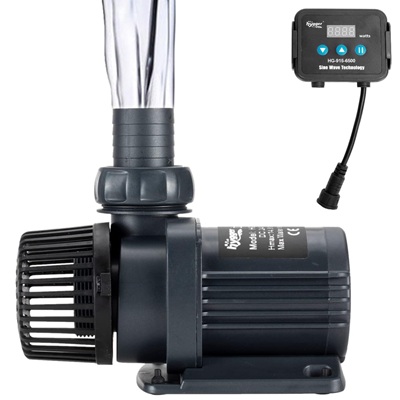
- Type
- DC, variable speed
- Control
- Controller, 30–100 % in steps
- Warranty
- 1 year
- In-line
- Yes, or submerged
- Sizes
- 800 GPH–2,650 GPH
- Head
- 9.8 ft–19.7 ft
- Draw
- 25–80 W flat out
- Street price
- $60–90 (2026-08)
| Size | Box says | Delivers at head | On the reference run | Right for · a year |
|---|---|---|---|---|
| 800 GPH · 25 W → | 800 GPH · 9.8 ft head | 1 m: 652 GPH · 2 m: 460 GPH · 3 m: 0 GPH | 559 GPH (70 % of rating) | 37–90 gal · turned down for 5.5–29 gal · $39/yr flat out |
| 1060 GPH · 33 W → | 1,060 GPH · 13.1 ft head | 1 m: 918 GPH · 2 m: 749 GPH · 3 m: 529 GPH | 781 GPH (74 % of rating) | 40–125 gal · turned down for 5.5–37 gal · $52/yr flat out |
| 1350 GPH · 40 W → | 1,350 GPH · 13.1 ft head | 1 m: 1,169 GPH · 2 m: 954 GPH · 3 m: 673 GPH | 935 GPH (69 % of rating) | 55–125 gal · turned down for 5.5–40 gal · $63/yr flat out |
| 1720 GPH · 55 W → | 1,720 GPH · 14.8 ft head | 1 m: 1,517 GPH · 2 m: 1,283 GPH · 3 m: 995 GPH | 1,149 GPH (67 % of rating) | 65–180 gal · turned down for 5.5–55 gal · $87/yr flat out |
| 2120 GPH · 65 W → | 2,120 GPH · 18 ft head | 1 m: 1,917 GPH · 2 m: 1,690 GPH · 3 m: 1,427 GPH | 1,401 GPH (66 % of rating) | 75–210 gal · turned down for 5.5–65 gal · $103/yr flat out |
| 2650 GPH · 80 W → | 2,650 GPH · 19.7 ft head | 1 m: 2,419 GPH · 2 m: 2,164 GPH · 3 m: 1,875 GPH | 1,632 GPH (62 % of rating) | 120–210 gal · turned down for 5.5–90 gal · $126/yr flat out |
"Box says" is the maker's zero-head flow and shut-off head (source: Product listings, re-checked 31 Aug 2026 — Hygger states flow, watts and max lift in every title, and the two sizes previously listed here matched theirs exactly); the size links go where the button below does. "Delivers at head" is the curve through those two numbers at 1, 2 and 3 m. "On the reference run" is the operating point on 1.2 m of lift, 1 in PVC, 3 m, two elbows, a ball valve and loc-line. "Right for" is the standard displays (plus a 25 % sump) it reaches 5–10× on at full speed, and the tanks it would need turning well down for; the year is at full draw, $0.18/kWh.
- Real head figures for the money — 14.8 ft on the 1720 is better than the Jebao 4000's.
- Submersible or in-line, and the controller's minimum of 30 % is low enough to be useful.
- A marketplace brand: the model in the listing and the model in the box have been known to differ, and the warranty is whatever the seller honors.
- Hygger sells more than one DC pump family at overlapping wattages — there is another 80 W pump rated 2,377 GPH at 13.1 ft, against this line's 2,650 at 19.7 — so buy by the flow and lift in the listing title, not by the wattage.
- Reviewers report controllers failing before pumps; budget for one.
- Not the pump to put under a tank of expensive coral without a spare.
Eheim compactON 3000
A sump where nothing needs adjusting, a quarantine or frag system, or anyone who has watched a DC controller die and wants one part instead of three.
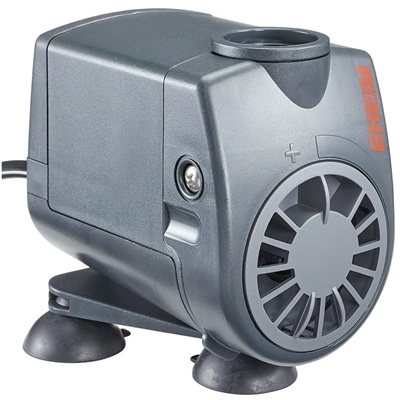
- Type
- AC, fixed speed
- Control
- None: a plug. Throttle with a valve on the outlet
- Warranty
- 3 years
- In-line
- Yes, or submerged
- Sizes
- 793 GPH–793 GPH
- Head
- 8.8 ft–8.8 ft
- Draw
- 55–55 W flat out
- Street price
- $130–155 (2026-08)
| Size | Box says | Delivers at head | On the reference run | Right for · a year |
|---|---|---|---|---|
| compactON 3000 · 55 W → | 793 GPH · 8.8 ft head | 1 m: 628 GPH · 2 m: 400 GPH · 3 m: 0 GPH | 527 GPH (67 % of rating) | 37–75 gal · turned down for 5.5–29 gal · $87/yr flat out |
"Box says" is the maker's zero-head flow and shut-off head (source: Bulk Reef Supply listing, re-checked 31 Aug 2026); the size links go where the button below does. "Delivers at head" is the curve through those two numbers at 1, 2 and 3 m. "On the reference run" is the operating point on 1.2 m of lift, 1 in PVC, 3 m, two elbows, a ball valve and loc-line. "Right for" is the standard displays (plus a 25 % sump) it reaches 5–10× on at full speed, and the tanks it would need turning well down for; the year is at full draw, $0.18/kWh.
- One part. No controller, no power brick, nothing to update; an AC pump that works today works in ten years.
- A three-year warranty on a pump that costs a third of the controllable ones.
- You cannot turn it down: throttling with a valve keeps the draw near maximum, so an AC pump sized generously costs its full wattage forever — the affinity table below is the argument against.
- An 8.8 ft shut-off head is the lowest on this page — fine under the tank, wrong for a basement sump, and it cannot reach the 2,000 L/h the affinity table compares everything at.
- 55 W for 792 GPH, all of it all the time. A DC pump delivering the same flow draws a fraction of it.
Sicce Syncra Silent 4.0
The AC pump worth buying if you want one: enough head for a real sump run, the quietest AC motor in the hobby, and a five-year warranty — bought knowing it will draw its full 80 W forever.
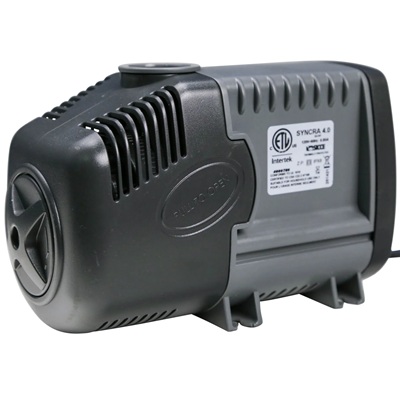
- Type
- AC, fixed speed
- Control
- None: a plug. Throttle with a valve on the outlet
- Warranty
- 5 years
- In-line
- Yes, or submerged
- Sizes
- 951 GPH–951 GPH
- Head
- 12.6 ft–12.6 ft
- Draw
- 80–80 W flat out
- Street price
- $180–200 (2026-08)
| Size | Box says | Delivers at head | On the reference run | Right for · a year |
|---|---|---|---|---|
| Syncra Silent 4.0 · 80 W → | 951 GPH · 12.6 ft head | 1 m: 818 GPH · 2 m: 658 GPH · 3 m: 445 GPH | 707 GPH (74 % of rating) | 40–125 gal · turned down for 5.5–37 gal · $126/yr flat out |
"Box says" is the maker's zero-head flow and shut-off head (source: Bulk Reef Supply listing, re-checked 31 Aug 2026); the size links go where the button below does. "Delivers at head" is the curve through those two numbers at 1, 2 and 3 m. "On the reference run" is the operating point on 1.2 m of lift, 1 in PVC, 3 m, two elbows, a ball valve and loc-line. "Right for" is the standard displays (plus a 25 % sump) it reaches 5–10× on at full speed, and the tanks it would need turning well down for; the year is at full draw, $0.18/kWh.
- Five years on the motor, which is as long as any DC pump here and on a part with nothing to fail but a bearing.
- 12.6 ft of head, so unlike the other AC pump here it actually reaches a normal sump run.
- Sicce's synchronous motor is the quietest AC pump in the hobby by consensus.
- It is the pump the whole DC argument is aimed at: 80 W flat out, every hour, where a DC pump delivering the same flow on our reference run draws a fraction of it — the affinity table below prices the difference.
- Six months on the impeller, which is the part that wears.
- Dearer than the Eheim by about $60 and dearer than several controllable DC pumps.
What a return pump really delivers at head
The rule of thumb says a pump loses 10 % of its flow per foot of head. A centrifugal pump does not: its head falls with the square of the flow, so it holds most of its rating over the first few feet and collapses only near its limit. On the reference run — about 2.8 m (9.1 ft) of total head, of which 1.2 m is the lift and the rest is pipe, fittings and the loc-line — the Sicce SDC 7.0 delivers 1,273 GPH, 67 % of its rating; the rule would predict 9 %. Two things the chart makes obvious: the pumps with the steep head figures (Vectra, SDC) barely notice the run, and the one AC pump collapses on it.
On the reference run at the SDC 7.0's flow: 1.2 m of lift, 0.67 m of pipe friction, 0.37 m for the two elbows and the valve, and 0.53 m for the loc-line — the nozzle costs more than the elbows, because it pushes the water out at 2.4 m/s. Swap the 1 in pipe for ¾ in and the same pump delivers 948 GPH at 2.9 m/s in the pipe, over the 2 m/s where lines get loud; add a swing check valve and it drops to 1,182 GPH. The pipe size and the outlet are the levers, not the elbow count — the calculator itemizes all of it.
DC vs AC: the power bill, at the same delivered flow
A DC pump's controller changes its speed, and a centrifugal pump's power goes as the cube of its speed: at 60 % speed it draws 22 % of its rating. An AC pump throttled by a valve on the outlet is still spinning at full speed against a partly closed valve, and draws close to its full rating whatever flow gets through. So the fair comparison is not the watts on the box — it is the watts each pump draws to deliver the same flow. Here is every pump in the comparison set to 2,000 L/h (528 GPH) on the reference run:
| Pump | Type | Speed for 528 GPH | Draw | A year |
|---|---|---|---|---|
| Sicce SDC 9.0 | DC | 51 % | 12 W | $19 |
| Hygger 2650 GPH | DC | 54 % | 12 W | $20 |
| Jebao / Jecod DCP-10000 | DC | 54 % | 12 W | $20 |
| Hygger 2120 GPH | DC | 58 % | 13 W | $20 |
| Sicce SDC 7.0 | DC | 61 % | 15 W | $24 |
| Hygger 1720 GPH | DC | 65 % | 15 W | $24 |
| Hygger 1350 GPH | DC | 73 % | 15 W | $24 |
| Jebao / Jecod DCP-6500 | DC | 65 % | 15 W | $24 |
| Jebao / Jecod DCP-5000 | DC | 73 % | 16 W | $25 |
| EcoTech M2 | DC | 55 % | 16 W | $25 |
| Jebao / Jecod DCP-4000 | DC | 79 % | 16 W | $25 |
| Neptune Systems COR-20 | DC | 56 % | 16 W | $25 |
| Hygger 1060 GPH | DC | 79 % | 16 W | $26 |
| Neptune Systems COR-15 | DC | 69 % | 16 W | $26 |
| Reef Octopus VarioS 8 | DC | 56 % | 17 W | $27 |
| Reef Octopus VarioS 6 | DC | 63 % | 18 W | $28 |
| Reef Octopus VarioS 4 | DC | 76 % | 18 W | $28 |
| EcoTech L2 | DC | 51 % | 20 W | $31 |
| Sicce SDC 6.0 | DC | 75 % | 21 W | $33 |
| Hygger 800 GPH | DC | 97 % | 23 W | $36 |
| EcoTech S2 | DC | 75 % | 31 W | $49 |
| Sicce Syncra Silent 4.0 | AC | full, valve closed down | 80 W | $126 |
Speed from the pump's curve scaled by the affinity laws (flow ∝ speed, head ∝ speed²) until it delivers 2,000 L/h on the reference run; DC draw = rated watts × speed³; AC draw = rated watts. A pump that cannot reach 2,000 L/h on the run at full speed is left out. Cost at $0.18/kWh, 24 h a day.
Read the table as a purchase decision. The Sicce SDC 9.0 does the job on 12 W; the Sicce Syncra Silent 4.0 does the same job on 80 W, every hour, for as long as you own it — the $108 a year difference pays for the DC pump's controller inside a couple of years. It is also why a DC pump one size up is not the waste it looks: the COR-20 at full speed moves 59 L/h per watt on this run, and turned down to what a 90 gallon needs it draws less than a nano powerhead.
The head figure is the spec that separates them
Two pumps with the same GPH and different shut-off heads are the same pump under the tank and different pumps everywhere else. The Jebao DCP-6500 and the Sicce SDC 7.0 are both "about 1,800 GPH" boxes; the Jebao's head is 14.8 ft, the Sicce's 16.5 ft. On the reference run that is 1,147 GPH against 1,273 GPH. Move the sump to the basement — 2.4 m of lift instead of 1.2 — and the Jebao delivers 911 GPH, the Sicce 1,050 GPH, and the Vectra M2 with its 21.5 ft 1,261 GPH. That is the whole case for the Vectra, and the whole reason the Jebao is a fine pump under the tank and the wrong one below it. The calculator prints the operating point for any two box numbers; the habit to build is reading the second number before the first.
The drain is the ceiling, not the pump
A return pump can only send up what the overflow can bring down. A single 1 in drain carries about 350 GPH as a quiet gravity drain and around 1,200 GPH as a tuned full siphon with headroom; a 1½ in siphon carries about 2,500. Buy a VarioS 8 for a tank with one 1 in Durso and the pump is not the limit — the overflow gurgling at three in the morning is. The calculator checks the drain against the delivered flow for every style of overflow; do that before choosing between two pumps, because it often chooses for you.
How return pumps fail
- The controller. The weak part of every DC pump, and the one that turns a pump off at 2 a.m. Symptoms: a pump that runs at one speed only, or not at all, with a motor that spins fine on a replacement box. On a Sicce or a Vectra the controller is a stocked part; on a marketplace pump it is a new pump.
- The power supply. The second weak part, and the cheapest fix — a 24 V brick. Keep it off the floor and out of the cabinet's humidity.
- Calcium on the impeller. A return pump in a reef sump runs in saturated water and slowly grows a crust on the impeller and the ceramic shaft; flow creeps down over months and the motor runs hot. A half-hour in vinegar twice a year restores it. The DC pumps that report their own flow (Vectra, COR) make the creep visible.
- The check valve that wasn't. A swing check on the return costs three elbows of head when it works and fails silently when a snail props it open — a siphon-break hole just under the surface costs nothing and cannot fail. The calculator counts the head; the failure mode is the reason.
- Running dry. A sump that drops below the pump intake on a big water change, or an ATO failure in the other direction. A magnet-drive pump survives a minute of it; ten minutes cooks the bearing. Every DC controller here has a low-flow shutdown; the AC pumps do not.
What we'd skip
- Sizing by the box GPH and "10 % per foot". The rule predicted 9 % of the rating on a normal run where the curve delivers 67 %; people who believe it buy pumps two sizes too big and then throttle them.
- An AC pump sized generously and choked with a valve. The affinity table is the argument: you pay full wattage for a fraction of the flow, forever.
- A swing check valve as the only protection against a back-siphon. A siphon-break hole does the job for free and cannot stick open.
- A pump whose only spec is GPH. If the listing does not print a shut-off head, you cannot draw its curve and neither can the calculator. Walk on.
- A DC pump with no spare, under a tank you would grieve for. Either the five-year warranty or the second pump in the cupboard — the cheap pump and the expensive one are both fine choices, and "cheap with no backup" is the one that isn't.
Common questions
Should the return pump be in the sump or plumbed in-line?
Every pump on this page runs either way. In the sump is simpler — no fittings under pressure, no chance of a leak on the suction side — and the pump's waste heat goes into the water, which a cool room may welcome and a warm one will not. In-line keeps the heat and the noise out of the cabinet and makes the pump easier to service, at the cost of two more sealed joints. If the sump is cramped or the tank runs warm, go in-line; otherwise start submerged.
Is it bad to run a DC pump at 40 %?
No — it is the whole point of buying one. A DC pump turned down runs cooler, quieter and on a fraction of the power, and the motor does not care. What you lose is headroom: at 40 % the pump has 16 % of its shut-off head, so a plumbing change that adds lift can stall it where it ran fine at 70 %. The sensible range is 50–80 % for a pump sized a little generously; if you find yourself at 30 %, you bought two sizes too big, and if you are at 100 %, you bought one too small.
How long do return pumps last?
The motor, five to ten years on any of these — a brushless DC motor and a magnet-driven impeller have almost nothing to wear but the ceramic shaft and bearing. The controller and its power supply are what fail, at two to five years, and on a cheap pump they are not sold separately. That is why the warranty length is on every card here, and why the honest strategy on a budget pump is a second one in the cupboard rather than faith in the first.